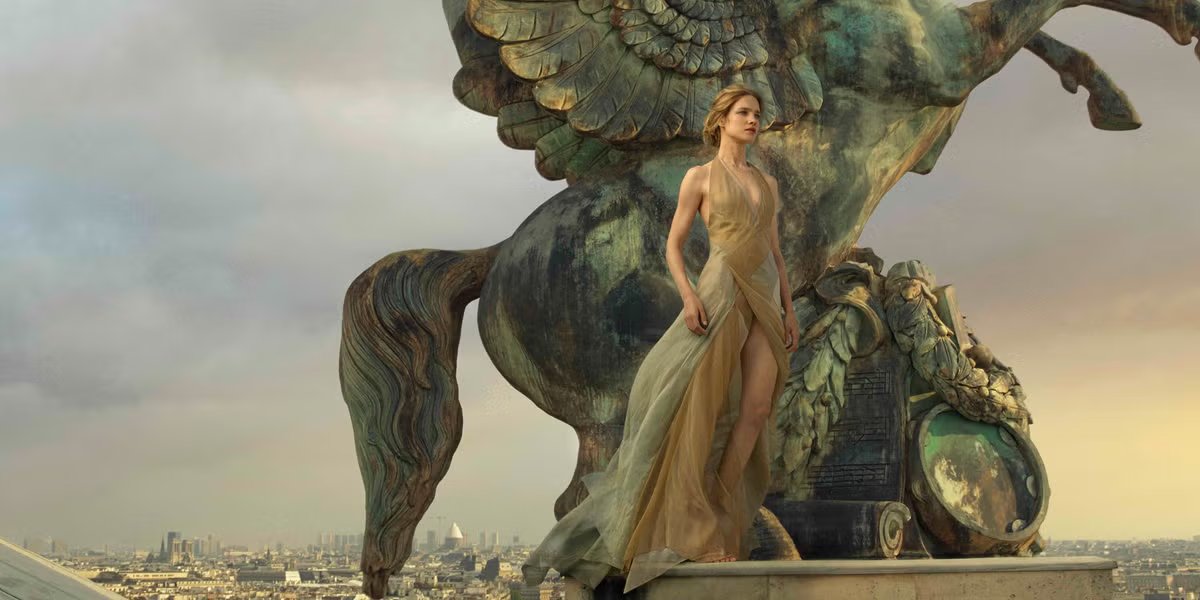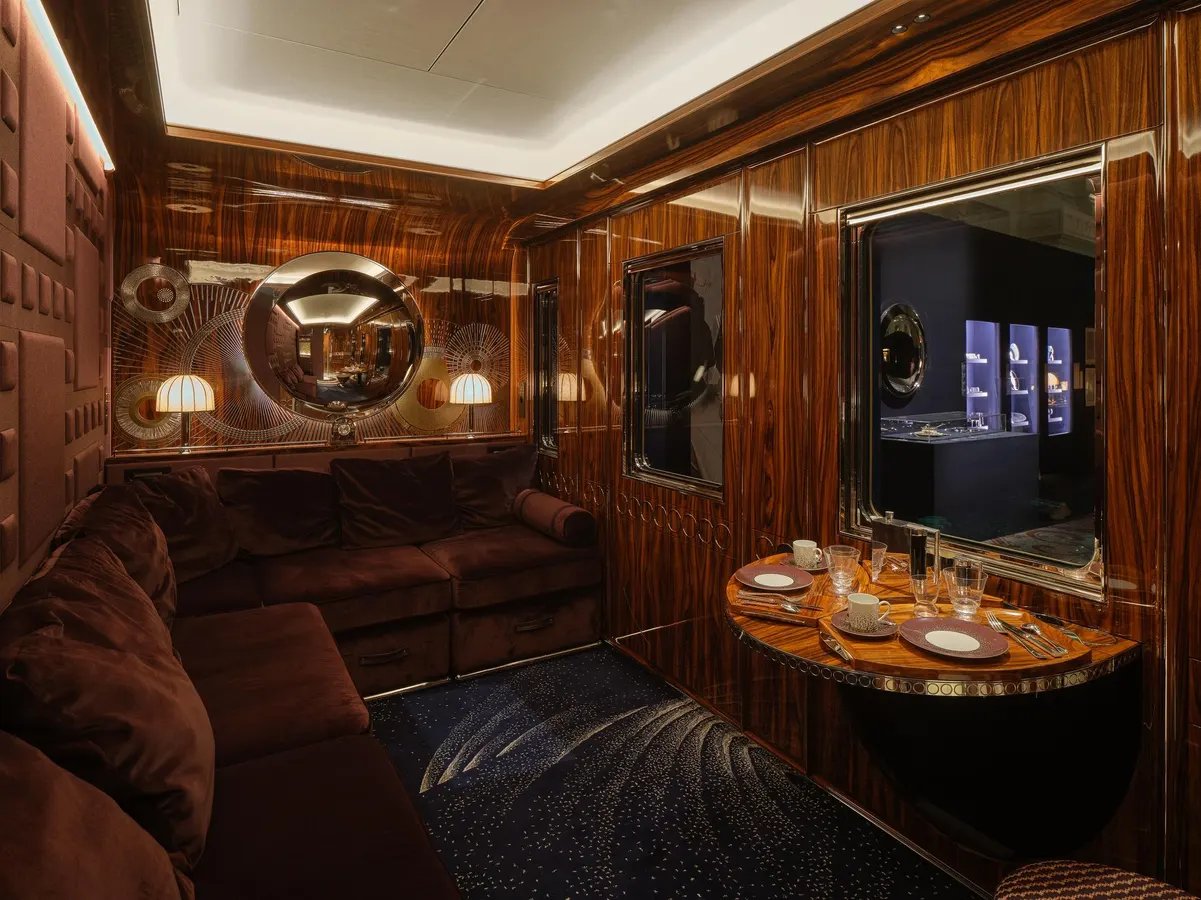

Scale model of the new Orient Express by Maxime d’Angeac, 2021-2025
Photo courtesy of Orient Express
Paris celebrates the centenary of Art Deco with the Musée des Arts Décoratifs’ new sweeping exhibition “1925–2025: One Hundred Years of Art Deco”. Art and design lovers are treated to a stunning retrospective of more than 1,000 works—from furniture and jewelry to posters, drawings and fashion—tracing the elegance, innovation and global influence of Art Deco. The show reflects on how the 1925 International Exhibition of Modern Decorative and Industrial Arts first propelled Art Deco from Paris to the world stage, while also demonstrating its continuing resonance today, with designers still drawing on its geometry, luxurious materials and spirit of craftsmanship. I speak with Lisa Jousset-Avi, the museum’s Assistant Curator of Modern and Contemporary Collections, to understand how this centennial exhibition bridges the past and present, and why the bold, refined language of Art Deco remains a vital source of inspiration.
The exhibition “1925-2025: One Hundred Years of Art Deco” commemorates the 1925 International Exhibition of Modern Decorative and Industrial Arts in Paris that first brought Art Deco to global prominence. What was the importance of the 1925 exhibition and what does revisiting this moment a century later reveal about the legacy and resilience of the style?
The 1925 exhibition was a major event that had a huge impact. Originally planned for earlier, but postponed due to the war, it showcased the work of designers, interior decorators and manufacturers, mainly from France. From the Concorde to the Invalides, all the pavilions have been destroyed, but the exhibition was extremely well documented and was a huge popular success. France was then a victorious country, with a vast colonial empire showcased in its own pavilion, supplying the objects, furniture and esthetic imagery on display with precious and exotic materials. Around 20 foreign countries were invited, and the United States, although absent, sent a delegation. There were also regional pavilions, as well as those of manufacturers such as Baccarat, Christofle, Fontaine and others. In celebrating Art Deco’s centenary, the Musée des Arts Décoratifs demonstrates its importance, its plurality of expression and the quality of its collections.
André Groult, chiffonnier, 1925, shagreen, beech, mahogany, ivory
Photo Christophe Dellière. Courtesy of Les Arts Décoratifs
Jewelry, fashion and decorative arts from Cartier, Madeleine Vionnet, Jeanne Lanvin, Sonia Delaunay and others also play a strong role in the exhibition. How important was interdisciplinarity—this crossing of design, architecture, fashion and applied arts—to the vitality of Art Deco?
This idea of interdisciplinarity is at the heart of Art Deco. The exhibition attempts to cover these different fields, putting creative processes into perspective and comparing esthetics. All of the museum’s collections have been used in the project to illustrate this key point: glassware, jewelry, silverware, graphic arts, wallpaper, furniture, tableware, fashion, ceramics, decorations, stained glass. It was through the effervescence of multi-talented designers and the collaboration between designers, craftsmen and manufacturers that interiors were conceived as a complete art form, hence the term “interior designer”, and Art Deco established itself in its total coherence.
One highlight of the exhibition is the spectacular Orient Express installation in the museum’s nave. How was the Orient Express the ultimate embodiment of the Art Deco style, and how does this dialog between a 1929 Art Deco train cabin and Maxime d’Angeac’s vision of the 21st-century Orient Express reflect the exhibition’s theme of heritage and innovation?
In the collective imagination, Art Deco is embodied through symbols: concepts such as the Roaring Twenties, flapper fashion, radiator caps, American skyscrapers and films such as The Great Gatsby. We wanted to evoke Art Deco through one of these symbols of 1920’s modernity—that of cross-border transport, which embodies luxury and has fueled the imagination ever since Agatha Christie’s Murder on the Orient Express—all while connecting it to the contemporary world to evoke the resonance of Art Deco today, thanks to Maxime d’Angeac’s new Orient Express. This highlight of the exhibition should allow visitors to understand how Art Deco can still be reinterpreted today.
Marguerite Pangon, cape, circa 1925, silk velvet dyed using the batik technique, silk satin
Photo Christophe Dellière. Courtesy of Les Arts Décoratifs
Describe some of the other highlight pieces displayed in the exhibition “1925-2025: One Hundred Years of Art Deco”.
It is difficult to choose from among the more than a thousand works in the exhibition. We are showing well-known masterpieces, such as Edgar Brandt’s spectacular Oasis screen, the Walking Panther and Cartier’s Bérénice necklace design. There is also Pierre Chareau’s ambassador’s desk-library, which is once again on display in the rooms, with its opening roof and Eugène Printz woodwork, André Groult’s Chiffonnier Anthropomorphe in shagreen with its rounded silhouette, restored for the occasion, Lanvin’s Cheik cape with its iridescent fabric and Eileen Gray’s lacquered Sirène chair. But we are also presenting lesser-known objects that are just as spectacular, such as the round Coard display case, Eugénie O’Kin’s ivory vase, a Jean Goulden enamel box, Claudius Linossier’s vases with geometric decorations, Marguerite Fray’s leather bindings and Madame Pangon’s colorful batik.
The exhibition features iconic designers such as Jacques-Émile Ruhlmann, Eileen Gray and Jean-Michel Frank, each representing different facets of Art Deco. What unites their approaches, and what makes their contributions stand out a century later?
The exhibition devotes rooms to different designers in order to illustrate the diversity of Art Deco esthetics and to understand their contributions to the movement through form, technique, motifs or the total art of interior design. Eileen Gray stands out for her interior design and her taste for cabinetmaking and lacquer techniques, while Ruhlmann demonstrates his mastery of line and contrast through materials. Frank economized on ornamentation by focusing on simple volumes clad in noble materials such as parchment, straw marquetry and mica. These approaches, which are not incompatible and often overlap, embody the effervescence of Art Deco and still influence contemporary designers today, such as Atelier Jallu.