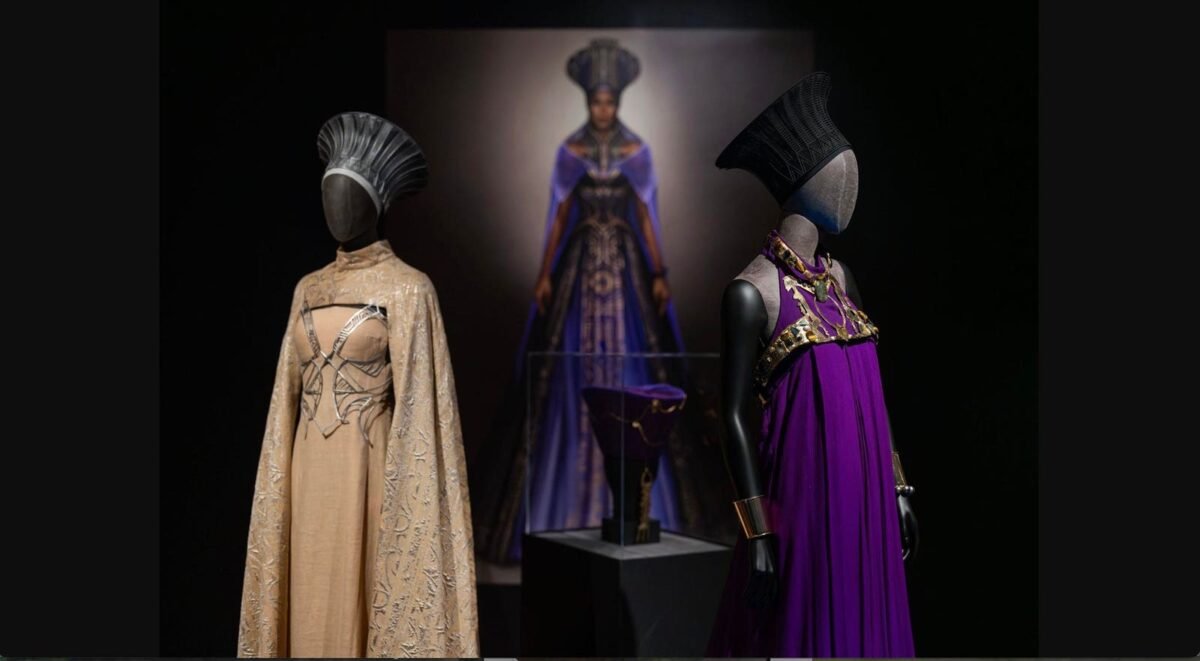

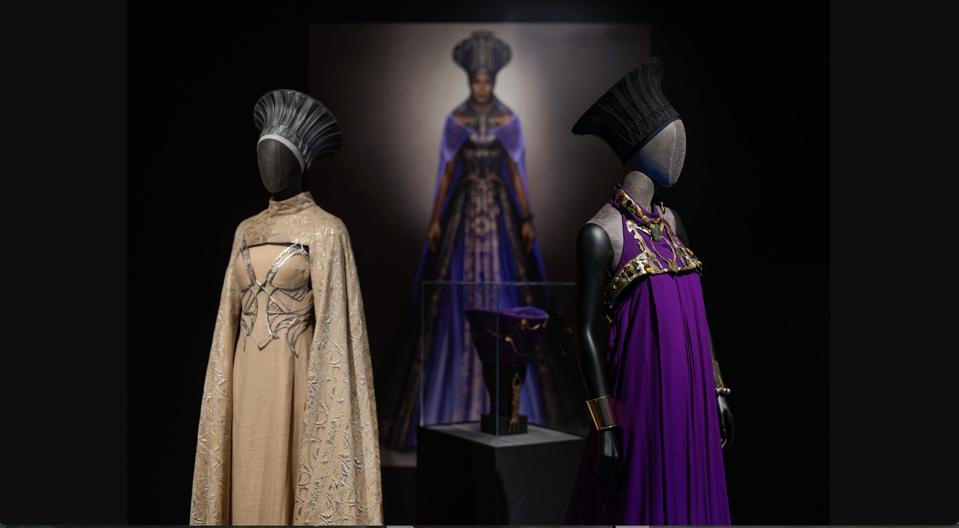
Douriean Fletcher Installation view of Douriean Fletcher: Jewelry of the Afrofuture at the Museum of Arts and Design, New York, NY. Photo: Jenna Bascom; courtesy the Museum of Arts and Design.
Jenna Bascom
Meticulously crafted from brass, gold, and semi-precious stones, award-winning multidisciplinary artist Douriean Fletcher’s intrepid sculptural jewelry amplifies Black identity imbued with spirituality. Best known for creating the jewelry and body armor for Marvel’s Black Panther (2018) and Black Panther: Wakanda Forever (2022), Fletcher’s singular Afrofuturistic aesthetic reflects her deep research into African and African American jewelry design. Fletcher invites us into her intricate visual narratives, seeking to unify, empower, and re-examine Black communities, countries, continents, and histories ravaged by colonialism, slavery, and oppression.
On view at the Museum of Arts and Design in New York through March 15, 2026, Douriean Fletcher: Jewelry of the Afrofuture traces the artist’s evolution from self-taught metalsmith to eminent designer whose exquisite handmade wearable art has transformed Black representation in contemporary cinema, especially the $2.2 billion-plus Marvel Studios’ Black Panther film franchise. The groundbreaking exhibition showcasing the trailblazing artist presents 75 works from Fletcher’s far-reaching collection.
Douriean Fletcher Installation view of Douriean Fletcher: Jewelry of the Afrofuture at the Museum of Arts and Design, New York, NY. Photo: Jenna Bascom; courtesy the Museum of Arts and Design.
Photo credit: Jenna Bascom
“We are defining the term (Afrofuture) as Black voices reaching to the past in order to better understand the future, which is similar to an idea of the Adinkra symbol, Sankofa, which uses this idea of looking back to the past to recognize our future,” said Sebastian Grant, co-curator at MAD, in an intimate conversation yesterday with Fletcher which was co-moderated by his co-curator Barbara Paris Gifford.
Sankofa (pronounced SAN-kaw-fah) is an Adinkra symbol representing concepts or aphorisms originating from the Akan people of Ghana. Its name comes from the Twi expression, “San kɔfa!”, which proclaims “Go back and get it!”, relating to lessons and practices of the past and how to draw on them to inform the present and the future.
“It means, literally, ‘to go back’, going back and seeing your past, (to) understand and recognize who you are in your present and where you were born. Those intersect in so many ways. You can see it throughout the exhibition as well. To me, Afrofuturism, adding the idea really means putting me, or one who identifies as Black or an African-American, in the middle of their own story, removing Eurocentric ideals beliefs, and really putting themselves in the middle of their fashion, their decor, their story, their identity, their religion, their spiritual beliefs, all of that, and finding strength in that many of us came to America,” Fletcher explained. “We lost a lot of that, and so I think it’s really empowering to be able to center oneself in that and navigate the world from that lens.”
NEW YORK, NY – OCTOBER 8: Barbara Paris Gifford, Douriean Fletcher and Sebastian Grant attend Museum of Arts and Design Celebrates Douriean Fletcher at Museum of Arts and Design on October 8, 2025 in New York. (Photo by Patrick McMullan/PMC/PMC) *** Local Caption *** Barbara Paris Gifford;Douriean Fletcher;Sebastian Grant
Patrick McMullan/PMC/PMC
During the discussion, Gifford presented imagery from the film – including the chest plate Fletcher created for Angela Bassett’s character Queen Ramonda who dies in Black Panther: Wakanda Forever when she is killed by Namor during his attack on Wakanda – to demonstrate Fletcher’s creative journey and the deep meaning and emotion emanating from her work for the first Black Panther movie. The range of feelings were magnified when Chadwick Boseman died on August 28, 2020, at the age of 43, after privately battling colon cancer since his diagnosis in 2016, and before the production of Black Panther: Wakanda Forever, and before the first draft of the film’s script was complete.
“Hearing you (Gifford) go through this process is making me quite emotional, because, oh my gosh, it definitely is, because when given this project, the entire crew and cast were all grappling with challenges,” Fletcher recalled. “You expect to see someone and they don’t come through the door, or just expect him to come into the costume design department and him not being there, so we’re all grappling with this idea that he’s not. … There was a lot of death, and so reading the script to understand what I needed to create was a lot. First we’re dealing with Chadwick or (King) T’Challa’s death, and then we’re dealing with the idea that Ramona, Angela Bassett, is passing.”
As Leo Tolstoy wrote in his 1897 book What Is Art? – “To evoke in oneself a feeling one has once experienced, and having evoked it in oneself, then, by means of movements, lines, colours, sounds, or forms expressed in words, so to transmit that feeling that others may experience the same feeling—this is the activity of art” – wrangling with Boseman’s death and the cinematic death of Bassett’s character during her creation process further elevates the fine art quality of Fletcher’s practice.
Riding the wave of emotion through Fletcher’s work, the ethos is to embrace the spiritual, historical, personal, and Afrofuturistic depth and scope of her art to evoke joy and human connection.
“When you come to MAD Ball, you can wear Douriean’s jewelry,” said MAD Chair Emerita Barbara Tober, who, along with MAD Director Tim Rodgers, welcomed guests yesterday.
The Oct. 29 gala will toast MAD Visionary honoree: renowned potter, designer, and author Jonathan Adler, who is widely recognized for his colorful, modern-glam style. The chic evening will be hosted by Adler’s husband, author, TV personality, and window dresser Simon Doonan, regarded for his provocative and whimsical displays at the luxury department store Barneys New York. The event begins with a gala dinner at Robert, a modern American restaurant offering breathtaking views of Central Park and Columbus Circle and situated atop MAD.
Douriean Fletcher Messenger Collection, gold and semi-precious stones, c. 2021.
Photo credit: Brittany Johnson.