[ad_1]
Opened within weeks of each other, the Hammer Museum presents a mind-bending show of Brown Art and Los Angeles County Museum of Art’s dazzling new Geffen Galleries introduce a new way to experience art
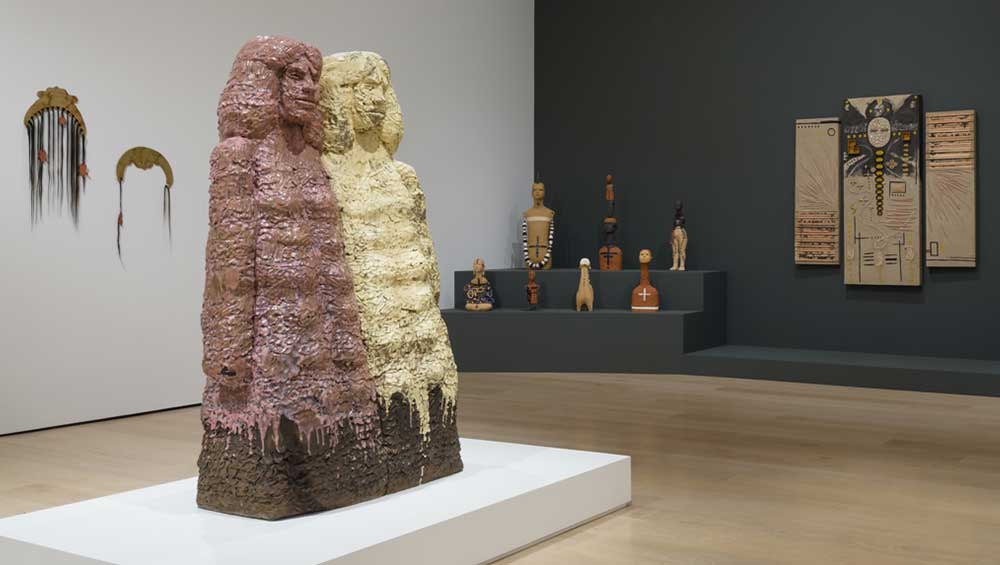
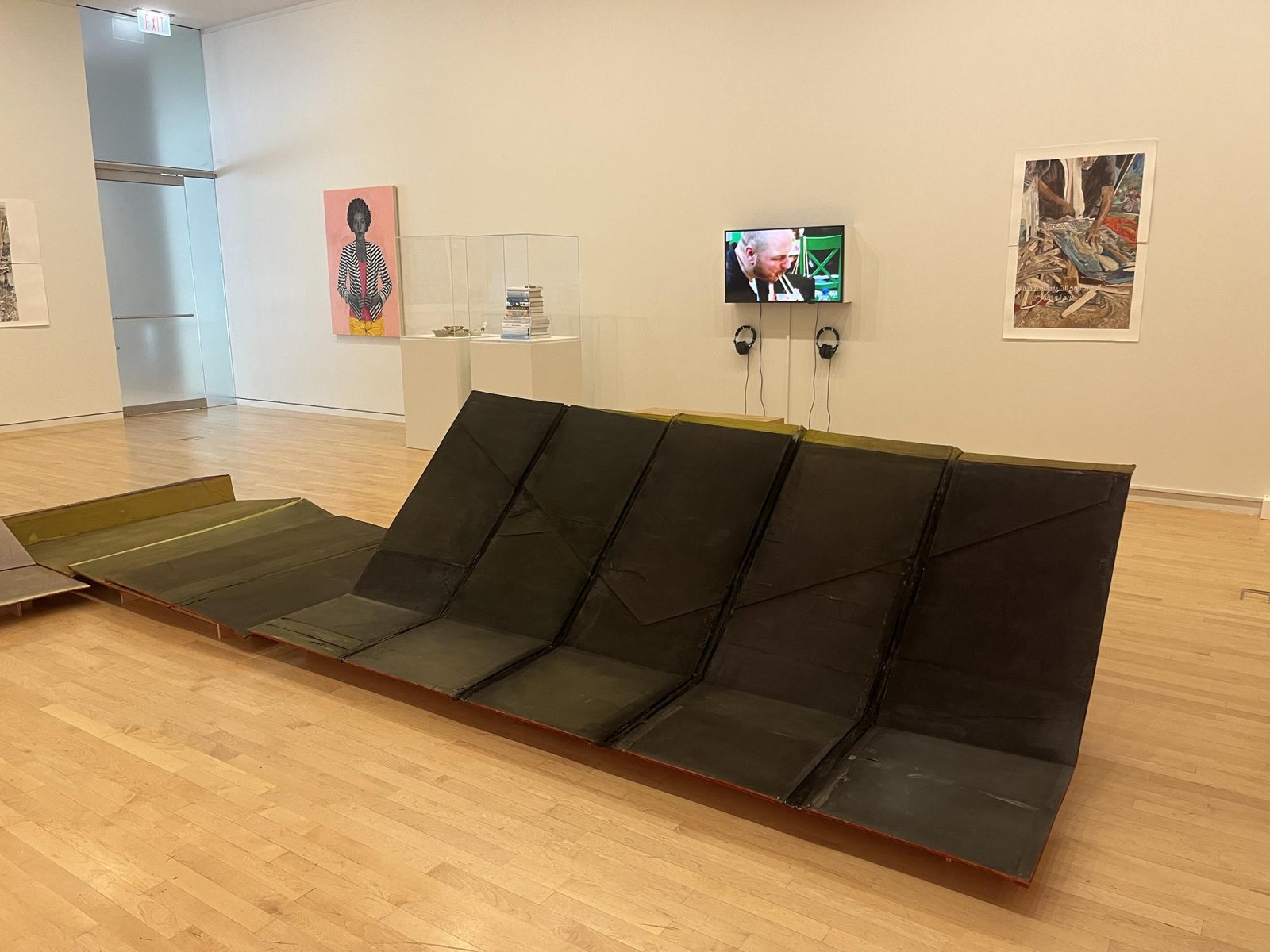
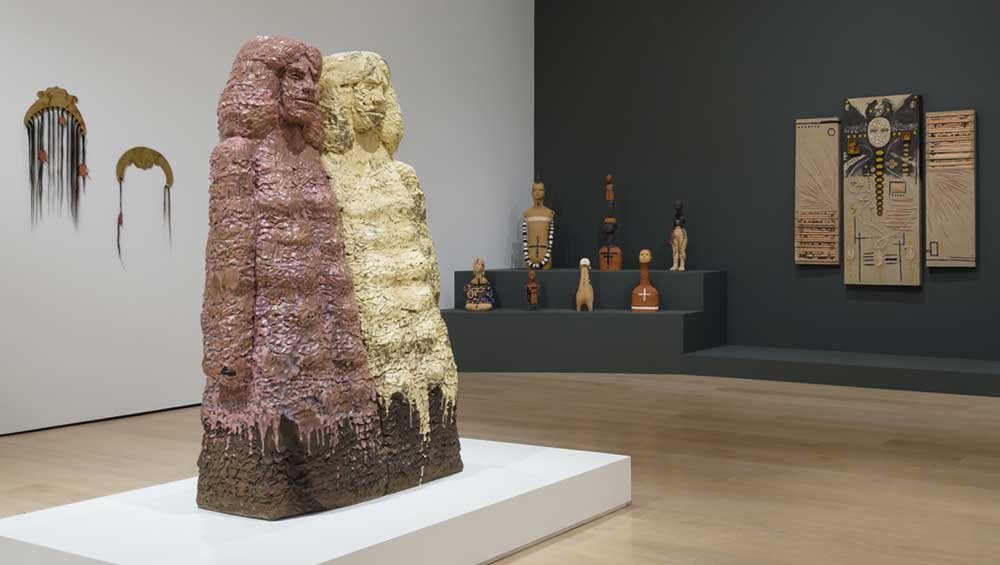
Several Eternities in a Day: Form in the Age of Living Materials, installation view. Hammer Museum, Los Angeles, 5 April – 23 August 2026. Photo: Jeff McLane.
Hammer Museum, Los Angeles
5 April – 23 August 2026
by JILL SPALDING
Their walls replete with Black Art, West Coast collectors have been chasing Indigenous artists. Coming off recent shows, Hector Dionicio Mendoza (at Luis De Jesus), Dyani White Hawk (at Various Small Fires), Jackie Amézquita (at Charlie James), Carmen Argote (at Commonwealth and Council), Raven Halfmoon (at the Hammer) and Jeffrey Gibson at the Broad) are among those who have been shifting the western gaze to precolonial worlds across the Americas that are animated less by race than by tradition, animal kinship and interaction with living materials.
Credit Several Eternities in a Day, the Hammer Museum’s eye-opening spring show, for introducing the concept of Brownness – a fluid identity that exceeds Latinidad by eschewing ethnographic jargon to designate not something you see but something you sense. The elemental immersion expressed in film-maker Ana Mendieta’s “earth-body” sculptures, for example, although she left Cuba as a child, was that of a sentient universe shaped by “eternities” of images, smells, atmosphere and cosmological knowledge. All the works here, although fashioned by a diaspora of art-makers engaging disparate mediums and differing aesthetics, spring from ancestral memory and a profound connection to nature as expressed in a visual language informed of animal kinship, earth, water and sky. Rivers flow to oceans, trees breathe, mountains shelter, fields nourish, and all that inhabit them live, feel and have inalienable rights.
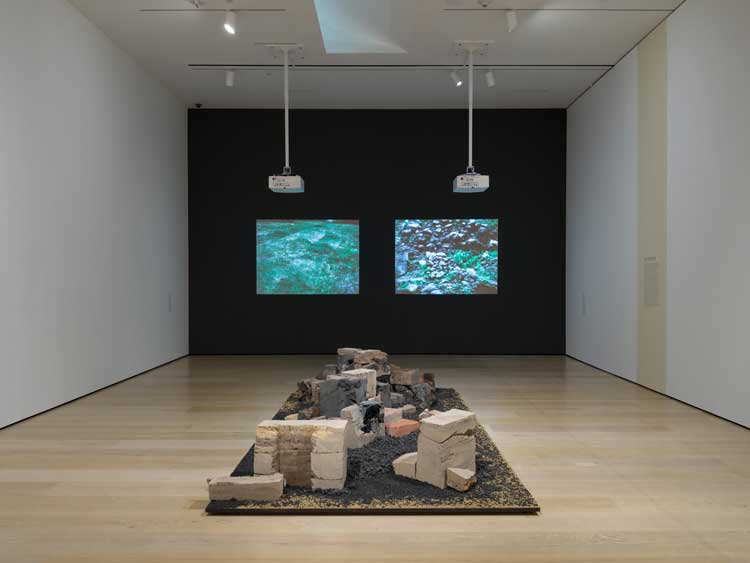
Several Eternities in a Day: Form in the Age of Living Materials, installation view. Hammer Museum, Los Angeles, 5 April – 23 August 2026. Photo: Jeff McLane.
So outside our experience is this vocabulary of Brownness that even the catalogue – albeit illuminating about inspiration and process – cannot fully communicate its spirituality, sensuality and fierce force. That the exhibition is laid out in three “acts” – large-scale installations formed of mineral and organic materials, painting and works on paper, and ceramics – is more an organisational device than the demarcation of artistic intention.
Although most of the artists here are known to the art world, having exhibited at such as the Tate Modern and the Whitney Museum of Art, this presentation is as visceral and fresh as if erupted from a long-dormant volcano.
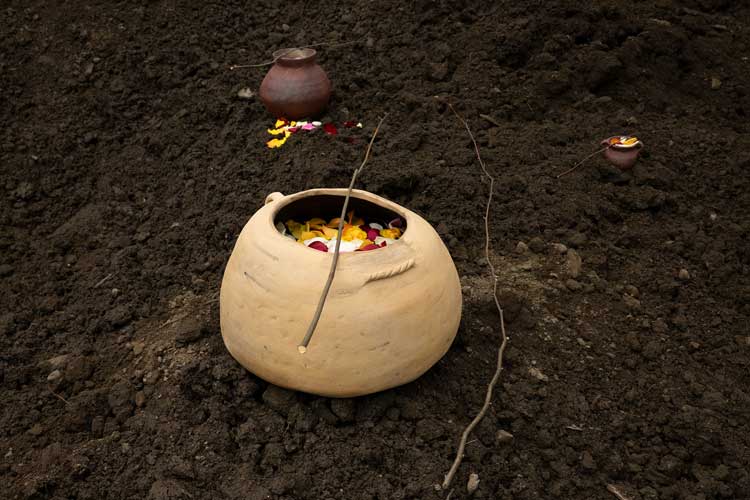
Edgar Calel, Installation view of Ni Musmut (It’s Breezing), Bergen Kunsthall, 2024. Oyonïk paruwi Juyu’ (Invocation over the mountains), 2024. Photo Thor Brødreskift.
Enter past a surrealist oil on canvas by the foundational Mesoamerican muralist Carlos Mérida and tunnel through the formidable landmass, Oyonïk paruwi Juyu’ (Invocation over the mountains) 2024, built by the Guatemalan Kaqchikel artist Edgar Calel of rock, earth, rose petals, and – signalling the food it will grow, in the Mayan belief that “everything in the world is inside us” – a flourish of rosemary.
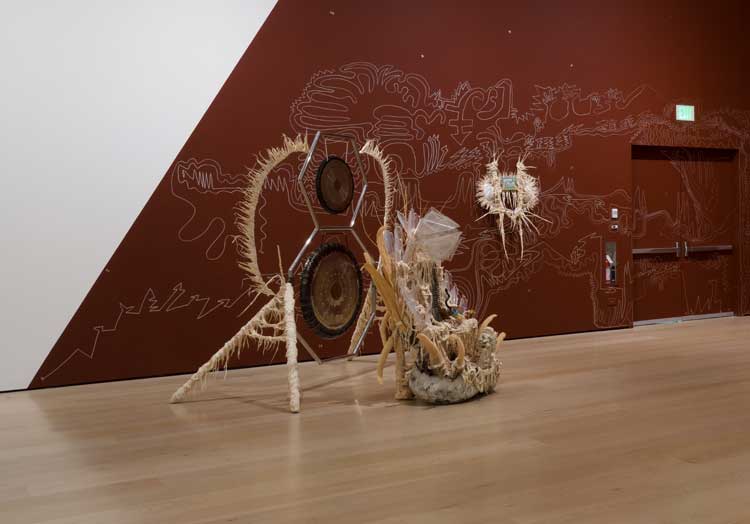
Guadalupe Maravilla, Disease Thrower #16, 2021. Installation view, Several Eternities in a Day: Form in the Age of Living Materials, Hammer Museum, Los Angeles, 5 April – 23 August 2026. Photo: Jeff McLane.
Emerge to witchy constructions by the self-styled mestizo Guadalupe Maravilla, which draw on his traumatic childhood in El Salvador for animistic evocations of ribs, lungs and disease-riddled limbs assembled with such unlikely objects as plastic toys, lampshades, sponges and lampshades picked up on his wanderings.
Time, transformation and change inform Argote’s outsized embodiments created by dragging her fingers through paper layered with avocados that will drip over time to “get closer to the skin, closer to the hand” and reveal ancestral psychological patterns through “private performance”.
Segue to the magical “mothers of plants” – healing figurative “spirits” wrought by Chilean artist Patricia Dominguez-Claro from bug-resistant tamshi vines, palm fibre, balsa wood and medicinal dyes.
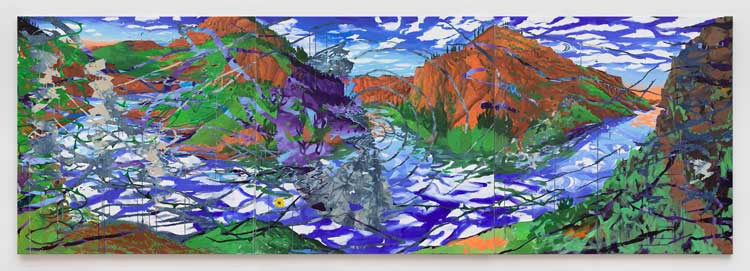
Esteban Cabeza de Baca, California via Colorado River via Rio Grande, 2025. Earth from Southwest United States with acrylic on indigo-dyed canvas, 60 × 180 × 2 in (152.4 × 457.2 × 5.1 cm). Courtesy of the artist and Garth Greenan Gallery, New York.
More challenging, in that it is admirable just as a painting, is San Ysidro artist Esteban Cabeza de Baca’s tangled, indigo-infused “cosmic” abstraction, California via Colorado River via Rio Grande (2025), a sprawling commingling of acrylic with earth carved with mystical symbols.
Channelling the prehistoric metamorphosis of clay into pottery, Argentinian Tucumano sculptor Gabriel Chaile’s functional ovens loom like ancient gods announcing a feast. Standing guard alongside them, a charming grouping of anthropomorphic totems that Pueblo artist Rose B Simpson has infused with the senses – “eyes, nose, mouth, ears” – to heal, and “give consciousness to the inanimate”.
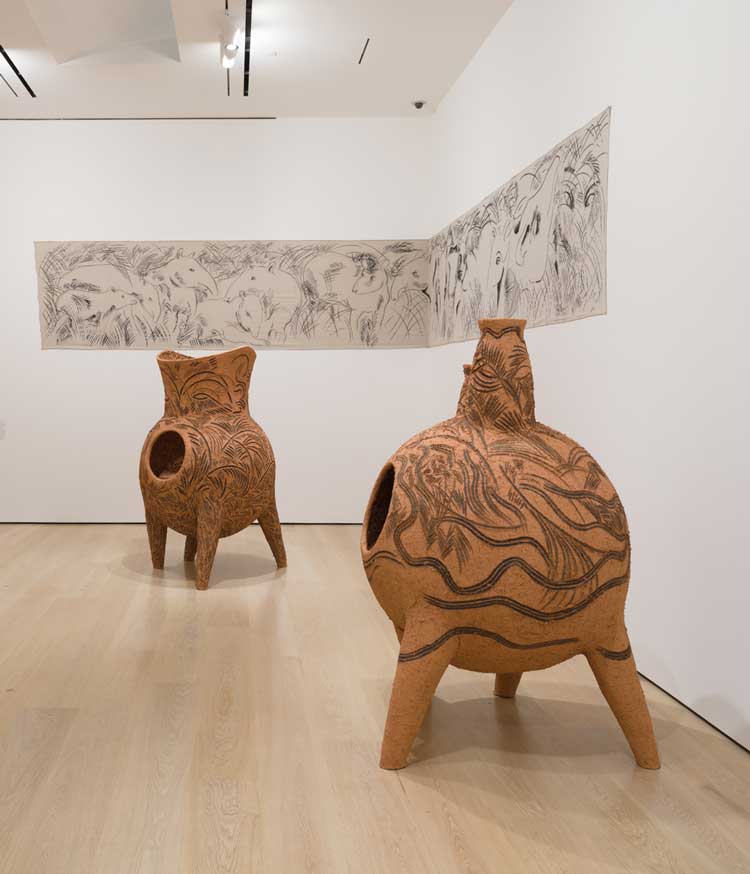
Gabriel Chaile, adobe oven sculptures. Installation view, Several Eternities in a Day: Form in the Age of Living Materials, Hammer Museum, Los Angeles, 5 April – 23 August 2026. Photo: Jeff McLane.
Give time to the film by Ho-Chunk Nation painter Sky Hopinka that layers archival materials, memories and landscapes to reclaim ancient narratives and debunk western portrayals of Indigenous histories best summarised by a quote lifted from the catalogue: “How can they exist in the contemporary moment without being seen as … akin to eating your vegetables?”
Exiting the Brown universe under a small but powerful zoomorphic ceramic by Oaxaca’s famed magical-surrealist artist Francisco Toledo, and across a sonic meditation floated above sand by Diné Pulitzer Prize composer Raven Chacon, you will understand art, not as an object (though it can manifest as such), not as a construct (though it can be constructed), nor as a displayable collectible, but as a life force experienced within you. You will retain less what you saw than what you felt, connected to the natural world by an everted sensation that opens you to both thinking about a river and being thought by a river. Your senses will long resonate with stones that speak, branches that animate, earth that breathes, clay that activates, water that resonates, and art shaped by craft that draws on climate, dreams, and memory.
The David Geffen Galleries Open
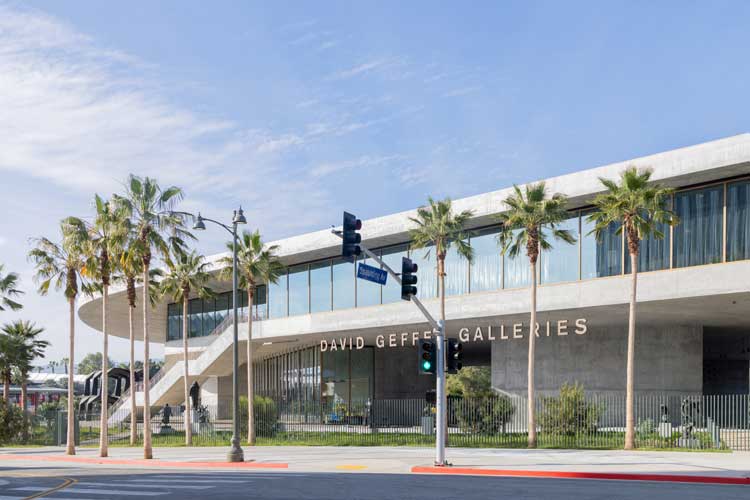
David Geffen Galleries at LACMA, exterior view northwest from Wilshire Boulevard, Photo © Iwan Baan.
OMG! It has finally opened! A cataclysmic 20 years in the making, the Los Angeles County Museum’s $724m (£532m) new wing is ready for its closeup and the whole art world is weighing in.
Predictions were dire; “forbidding”, “totalitarian”, “a white elephant”, “suicide by architecture”.“Confusing” was the mildest word for the rethink that Lacma’s director, Michael Govan, holds mission accomplished. Defying convention, the Swiss minimalist architect Peter Zumthor – no novice to museum building though his previous triumphs are far smaller – has fashioned 110,000 sq ft (10,220 sq metres) of concrete to loop a 900ft-long (274 metre) single level of show space 30ft (9 metres) over Wilshire Boulevard.
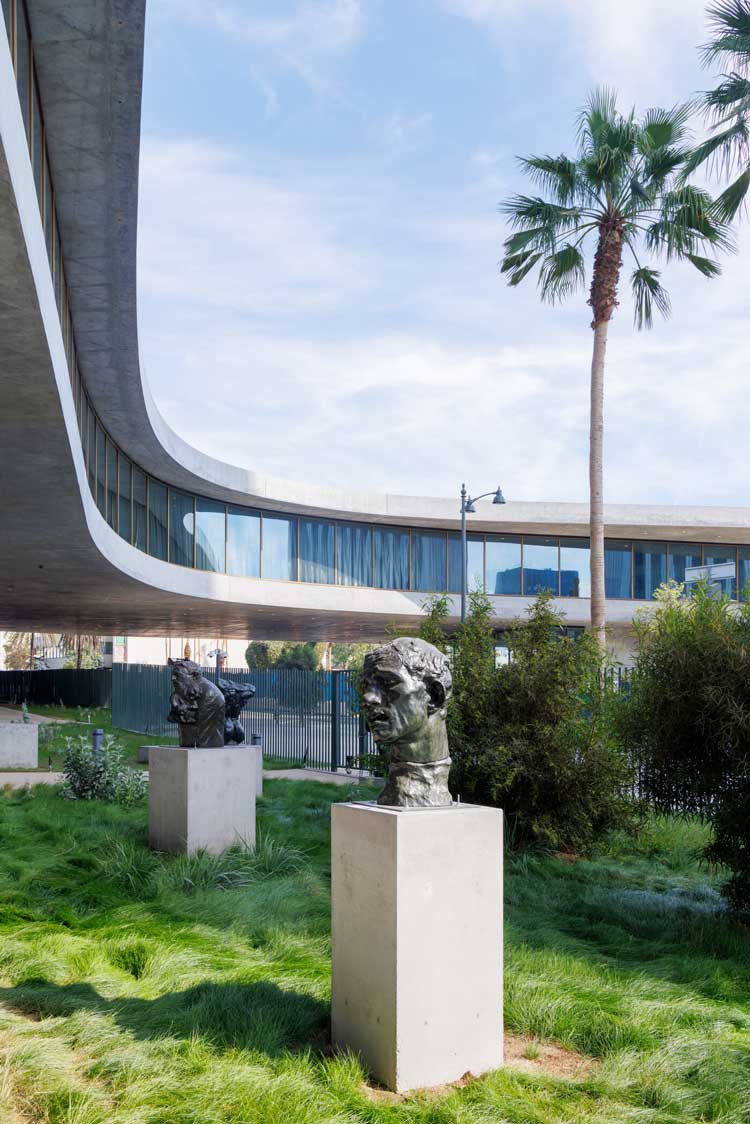
Iris and B. Gerald Cantor Sculpture Garden with Auguste Rodin’s Monumental Head of Pierre de Wissant (1884–85) in foreground, David Geffen Galleries at LACM. Photo © Iwan Baan.
Asked at a preview, Why revive concrete?, the Pritzker-prize-winning architect replied: “That it might last 500 years!” Why bridge it over traffic? “To reach out to the city!” Although he acknowledged the nod to brutalism, this curvaceous concrete edifice is no revival. Owing nothing to New York’s two industrial fortress-museums built for the Whitney by Marcel Breuer and Renzo Piano, Lacma’s new showspace was informed by mid-century modernism – think Rudolph Schindler and Richard Neutra – a seamless fusion of indoor-outdoor space and floor-to-ceiling glass walls cantilevered over a living landscape reaching out to the Pacific.
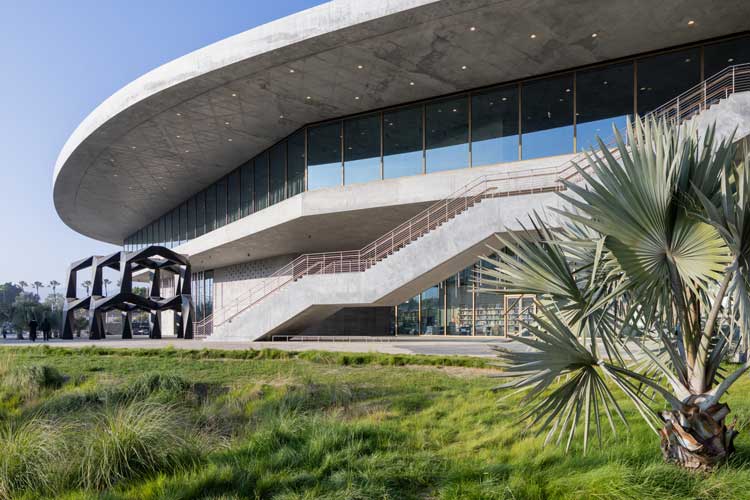
Exterior view northwest from Wilshire Boulevard with Tony Smith’s Smoke (1967) at left, David Geffen Galleries at LACMA, art © Tony Smith Estate / Artists Rights Society (ARS), New York. Photo © Iwan Baan.
More western habitat than museum, the viewing area is restricted to one level, accessed directly by elevator or, via external steel stairways, a glass door. That the entire outer wall is given over to windows places the art in spectacular dialogue with the cityscape of mountains, ocean, traffic and the LA landmark architecture of Bruce Goff’s quirky Japanese Pavilion, the streamline-moderne Academy of Motion Pictures, the veil-and-vault Broad and, if you drive along Wilshire Boulevard and look up, with you.
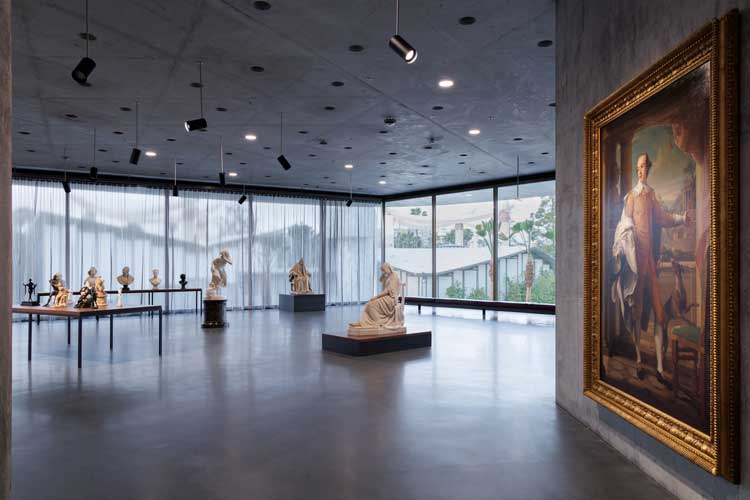
Classical Revivals in Europe and America with Pompeo Batoni’s Portrait of Sir Wyndham Knatchbull-Wyndham (1758–59) at right, David Geffen Galleries at LACMA. Photo © Iwan Baan.
Only deceptively raw, its art-bearing concrete walls are subtly painted to complement a rotating collection and intermittently softened by sprawling textiles spared the harsh glare of daylight by hi-tech fabric curtains – the museum’s largest artwork – that Tokyo textile designer Reiko Sudō has woven in shimmering metals. An engineering marvel, conceived to survive earthquakes, the entire structure was floated, designed to slide up to five feet – even “jump”.
All well and good sighed the curators, but that left only the inner walls, the alcoves and inlets they feed into, a narrow, curving walkway and a mere handful of galleries to display 2,500 objects. More challenging still was how to stage Govan’s momentous rethink; jettison the Eurocentric, western canon, assemblage that for so long has shaped viewing in favour of an archipelago of installations organised around the world’s major waterways – Pacific, Indian, Atlantic and Mediterranean – to showcase a history of art produced by 6,000 years of global migration and cultural exchange.
Appalled, several curators resigned, and the public weighed in. Why mishmash eras? Why reduce the exhibition space by replacing two serviceable older structures for galleries on one level whose entire outer wall is given over to views?
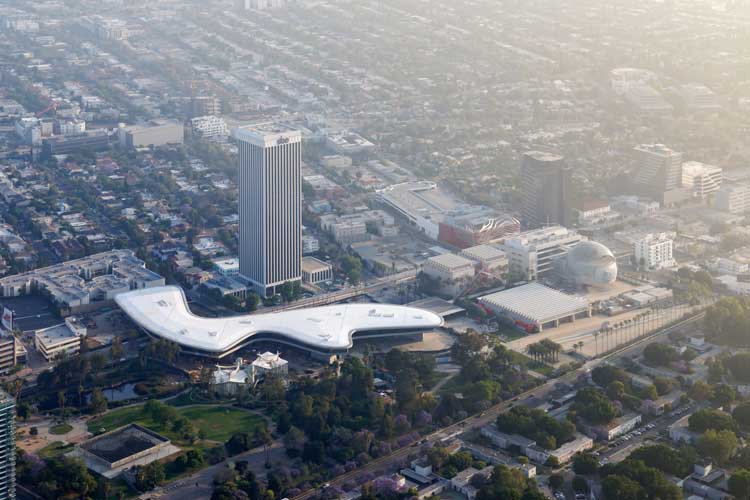
Aerial view of LACMA buildings, including David Geffen Galleries in context of Miracle Mile. Photo © Iwan Baan.
For Govan, these are compliments. The footprint, he insists, has not shrunk, because the 3.4 acres (1.38 hectares) opened to creative landscaping and sculpture will double the show space, and rotating objects from the 150,000 stored in the archives will assure that no two visits will be the same. Most critically, guided by serendipity, viewers will make connections between artworks that will deliver a new way of seeing. Paintings, sculpture, textiles and objects grouped not to march you through time but to reveal an interconnectedness and invite contemplative engagement.
Few bought it. Even on opening night, those converted to rapture held the new wing “disorienting”, and all thought it “radical”.
My take is “revolutionary”, an upending of the viewing experience that every museum must now heed. Designed to prioritise looking over learning, captions are small and at a distance from the works, and the non-chronological layout is designed so that you meander through and around, in and out, back and forth – more adventure than museum.
Mischievously labyrinthian in its tacit intention to get you momentarily lost, ocean-area grouping wanders you along batiks, photographs, totems, ceramics, portraits and costumes to make connections that have little to do with art history. Installations linking the dynamic interrelation of nature and culture, atmospheric drift and migration, prioritise contemplative engagement over historical narrative.
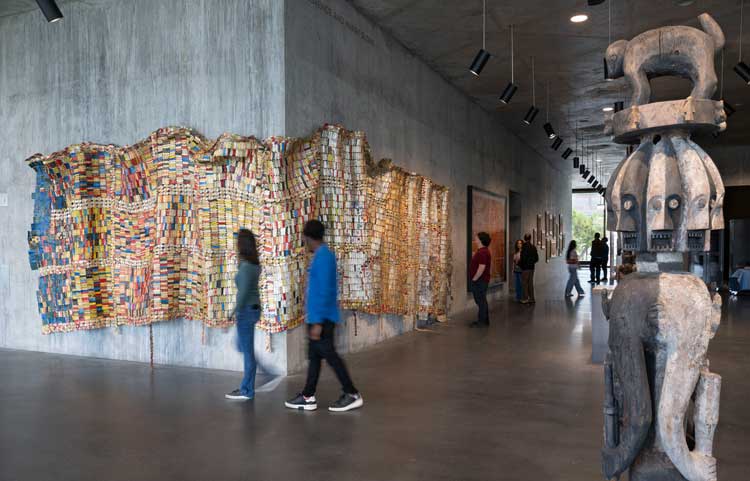
Installation view of the inaugural presentation in the David Geffen Galleries, April 2026. Photo © Museum Associates / LACMA.
Inspired installation wraps the shining metallic 2007 El Anatsui Fading Scroll around the corner and offers the cherished 1953 Matisse ceramic-tile La Gerbe its own wall; sets Raymond Loewy’s gleaming 1951 Studebaker against a muted 1954 Ruth Asawa wire sculpture; places Bahamian artist Tavares Strachan’s 2024 marble bust against a late period bronze statue of the Egyptian goddess Bastet, and a Polynesian totem next to Gail Mabo’s 2018 Mer Island combine, worked with twine, bamboo and shell. Creative juxtaposition looms Diego Rivera’s beloved Mesoamerican-modernist Dia de Flores over one of the diminutive stone deities he collected, plays famed surfer Duke Kahanamoku’s iconic 1920s surfboard by his brother, carver David Kohanamoku, off a 2016 inkjet print by Maori artist Lisa Reihana, and faces mid-19th century silver prints by South Korean photographer Han Youngsoo on intricate Kashmiri weavings.
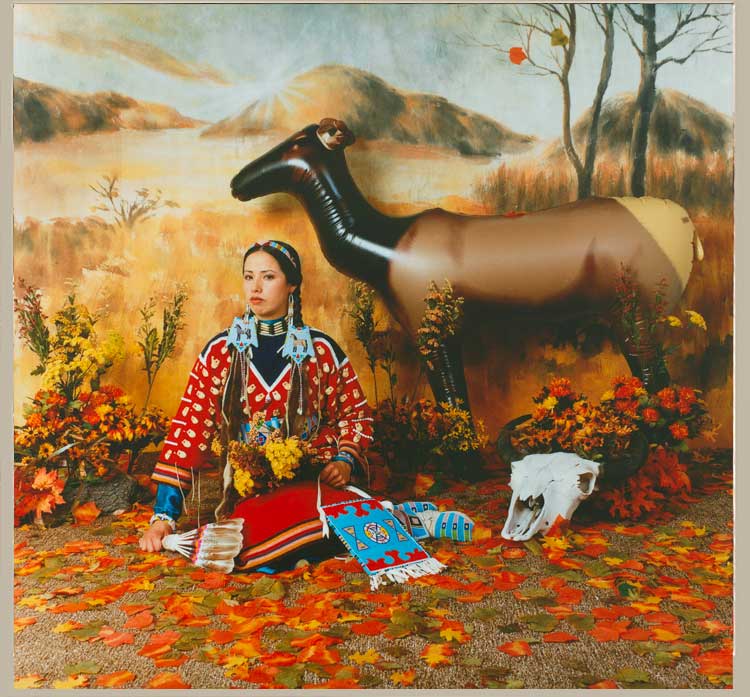
Wendy Red Star, Fall, 2006 (printed 2023). Installation view of the inaugural presentation in the David Geffen Galleries, April 2026. Photo: Jill Spalding.
Revelatory, too, the gallery installed to flip the cowboy culture cliche. An archetypical bronze 19th-century Frederic Remington bucking bronco played off against Luis Jiménez’s 1978 fibreglass Mexican-American Vaquero, and a 2010s Richard Prince photograph Untitled (cowboy) faced on Indigenous (Crow) artist Wendy Red Star’s 2020s painting of a girl and her horse and Raven Halfmoon’s muscular ceramic cowgirl, On the Lookout for Choctaw Ponies (2023), rewrite the legend of the American West.
The few heavy manifestos, such as San Francisco activist Yolanda López’s finger-pointing Aztec Warrior asking “Who’s the illegal alien, PILGRIM?”, are offset by contemplative works such as light and space artist Larry Bell’s signature colour-shifting glass cube, 1996 Untitled – its gradient layers “sublimated, evaporated and coated in gradient layers with silicon monoxide and chromium”. A curatorial nightmare but thrilling, along the narrow wraparound walkway ceramic totems hang unprotected, groupings of ancient pottery exchange vitrines for open-to-touching waist-high table displays, fragile gilding is exposed to close viewing and and no pedestals safely raise the ancient marble deities in their walk-through agora.
Impossible not to admire the meticulously mounted Damascus Courtyard Home and every one of the works commissioned to cover a wall: Do Ho Suh’s translucent Jagyeong Hall, Gyeongbok Palace (2026), a closely stitched, drawn, and tinted fabric re-creation of a section of Seoul’s famed Joseon palace; Todd Gray’s Octavia Gaze (2025), a 27ft (8.2 metre) assemblage of framed photographs that challenge western art history with evocations of Ghanian village life under colonial subjugation; and the two 60ft-long ink rubbings on cotton that the Mexican artist Mariana Castillo Debar made from her “islands” in the plaza, showing traces of the immigrants hands that had fixed them into the ground, animal tracks referencing the tar-pit fossils beneath them, and sections of Quetzalcoatl, Mezoamerica’s revered feathered serpent, thought to unit earth and sky. Flanking them and the boldly signed donor of $150m, a massive carved lava sculpture, Tlali (2026), that Pedro Reyes tweaked from the one that caused an uproar in Mexico for its representation of an Indigenous woman by a male, non-Indigenous artist.
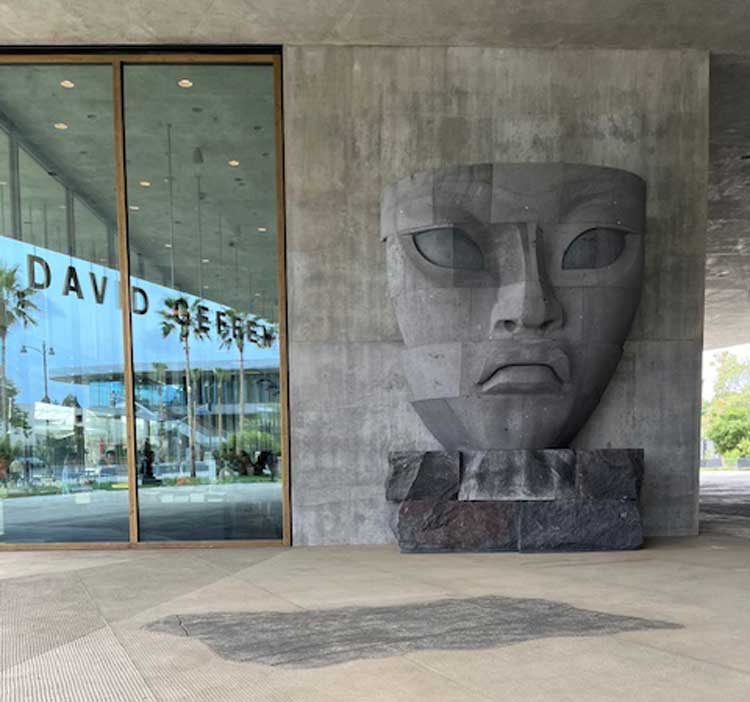
Pedro Reyes, Tlali, 2026, installation view, the David Geffen Galleries, April 2026. Photo: Jill Spalding.
What did I love? An installation of plastic as art when crafted by masters; the gallery flashed by such high-intensity kinetic works that you are cautioned against entry; the wondrous Safavid Ardabil Carpet, lit as though from within, matched only by the one in the Victoria and Albert museum; still before my eyes, Naples Yellow and Mica (2013), Pat Steir’s massive sun-and-rock conjoining painted canvas; Sea of Buddha (1995), Hiroshi Sugimoto’s gelatin silver print reigning darkly over vividly painted Tibetan chests; faced on each other, Oceans l, ll, lV and V, Andreas Gursky’s vast, digitally manipulated, deep sea reflections of an impenetrable sky; and, floated in an intimate gallery, Katsushika Hokusai’s 1831 The Great Wave off Kanagawa and two other luminous Japanese screens conveying the many moods of water – snow, mist, clouds, waves, waterfalls – that connect Shinto, Daoist, and Buddhist religions. Insightful to reveal the depth and quality of the Dutch paintings Mr and Mrs Edward Carter conferred on Lacma by pairing Adriaen Coorte’s intimate still life Strawberries in a Wan-Li Bowl (1704) with Ambrosius Bosschaert’s large-scale Bouquet of Flowers on a Ledge (1619). Masterful, too, how, given its own wall, Francis Bacon’s heretofore disquieting 1969 triptych, Three Studies of Lucian Freud, now romances you.
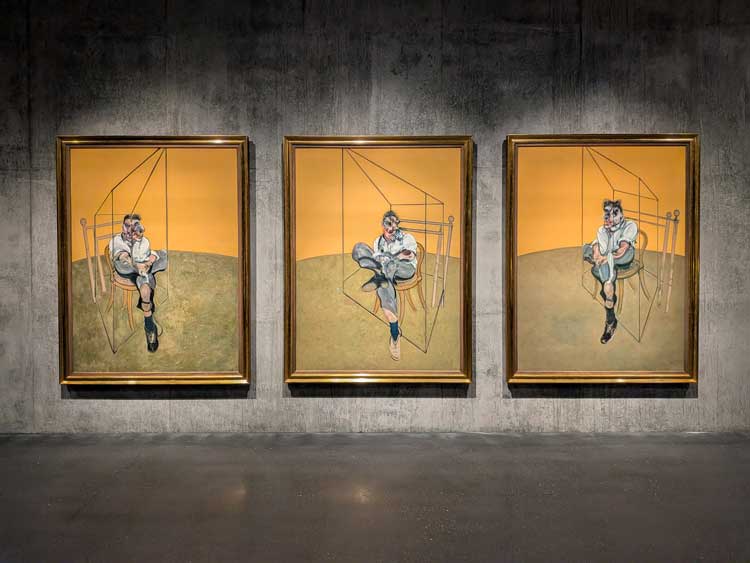
Francis Bacon’s 1969 triptych, Installation view of the inaugural presentation in the David Geffen Galleries, April 2026. Photo © Museum Associates / LACMA.
There’s no denying the confusion. Those not of the art world left bewildered and even the insiders cited brain-fatigue. Mind-bending and exhausting it may be, but Lacma’s new wing is also personal, intimate and deeply rewarding. Even a curator from the Getty, albeit hugely critical after touring, was heard to say of the museum’s imminent year-long-plus shutdown: “Maybe we should do a small rethink of the hanging.”
And there you have it. To the purist I ask, have you not toured an English country manor or an estate from the gilded era, where the gentry displayed African masks next to medieval armour and Staffordshire pottery under a Louis XIV tapestry or the Canaletto shipped from their travels abroad?
Yes, there are glitches; the lighting is too dim at night, too bright at noon and, visiting at midday, I saw a guard fanning herself. But light and temperature can be adjusted.
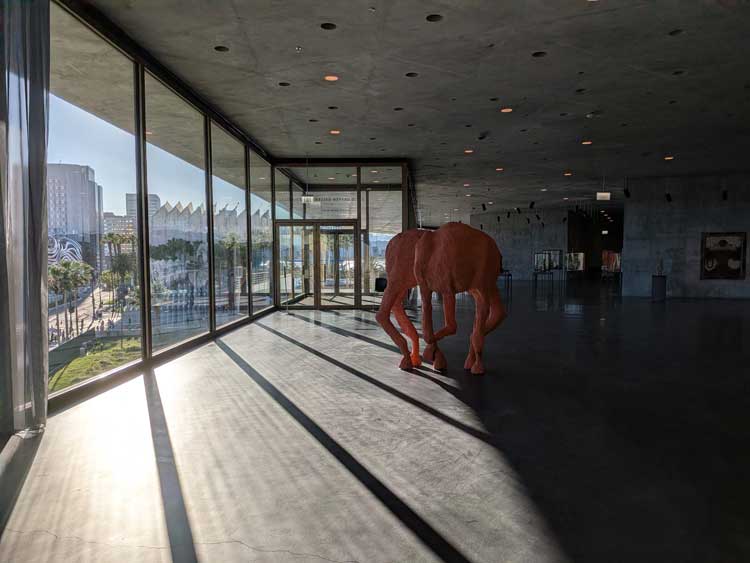
Installation view of the inaugural presentation in the David Geffen Galleries, April 2026. Photo © Museum Associates / LACMA.
I do have two small cavils and one large objection. Although Zumthor promises that an anchor-based mounting will delightfully pattern the walls over time, how will drilling not compromise the concrete as the collection keeps rotating? And that Jeff Koons’s mammoth Split-Rocker topiary is squished into a small lot across the boulevard positions it less as art than as a signpost to the coming restaurant and theatre.
More critically, as Lacma is funded by taxpayers, that so little of its permanent collection will be accessible on one viewing calls into question the hefty $30 per person entry charge, $23 parking fee, pricey restaurants, a $90 annual membership fee and free admission only the second Tuesday (a workday!) of each month.
Would that the people’s museum had taken its cue from the Hammer – free entry to every viewing experience – even the current one that will for ever change how to think about art.
[ad_2]
Source link