[ad_1]
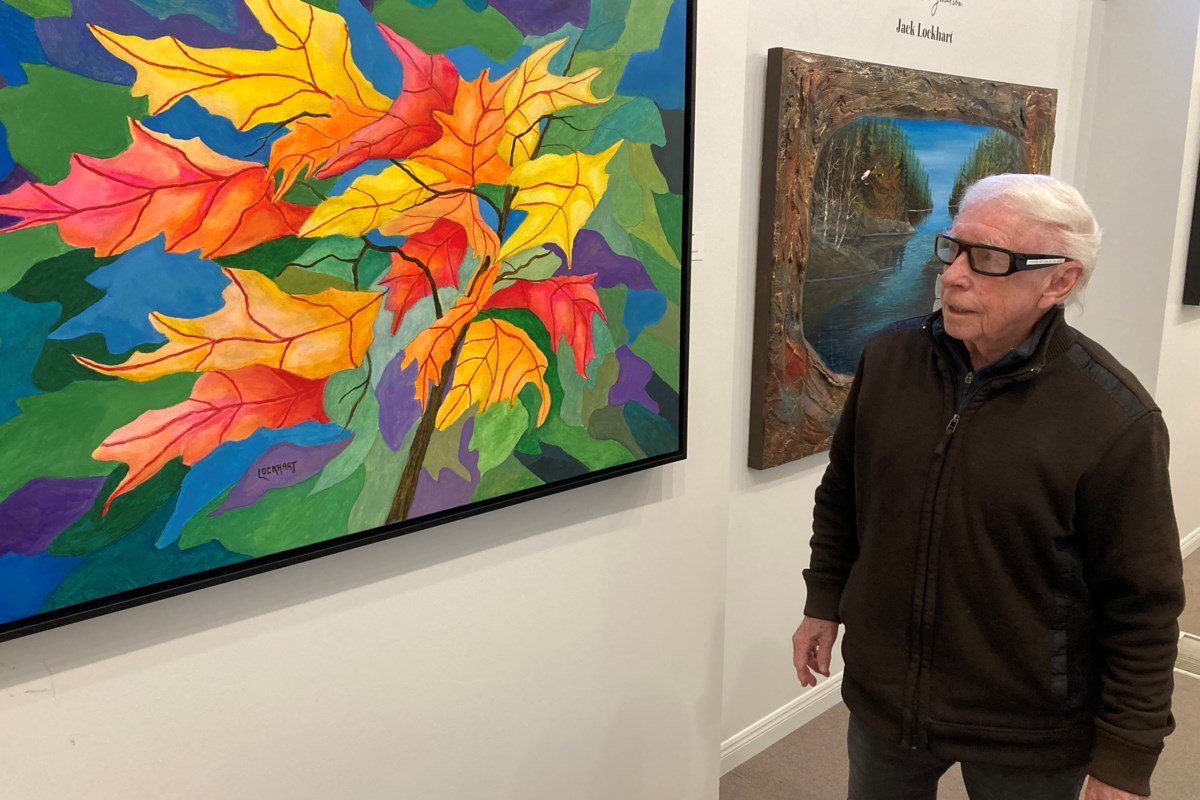
Beyond Imagination, a new solo exhibition by artist Jack Lockhart, takes people through 60 years of creative artistry and the development of innovative techniques
As the saying goes, ‘I may not know much about art, but I know what I like.”
It turns out that there is plenty to like at an art exhibit by local painter Jack Lockhart, currently on display at the Alex Dufresne Art Gallery in Callander.
His show “Beyond Imagination” takes people on a journey through 60 years of artistic genius.
While Lockhart calls North Bay home, this internationally known Canadian artist’s work can be found in personal and corporate collections,including those owned by former Prime Ministers, Lieutenant-Governors, Canadian and US Ambassadors, as well as celebrities such as singer Michael Burgess, and hockey great Bobby Orr
In this current exhibition, the walls of the gallery are covered with roughly 35 paintings, in various styles.
“So, it is a retrospective of a lot of work over 60 years of painting. Some people might even see how it has evolved when they look at the paintings, and say ‘Oh yeah, I remember when you did this style, and it continues on,” explained Lockhart.
Best known for his work in watercolour, acrylic and oil, the artist’s work has evolved to the point where he also now paints in 3D.
“You don’t often see that, especially with how I do it and how it is portrayed and put into the exhibit. Sometimes you will even see some paintings that are 3D accidentally. It is just the way the colours are because it is all based on colour.”
Lockhart recalls when 3D was in its infancy.
“We remember when movies had 3D, and the image was fuzzy, and they gave you a pair of glasses that had a blue lens and a red lens. You put those on and somehow that tied the fuzzy image together and made it 3D,” Lockhart explained.
“This is an absolutely different concept completely. I always thought to myself, wouldn’t it be nice if you could do a painting and it was finished just like it is, but you have some way of making it 3D without even touching it, just let it go.”
Along came ChromaDepth glasses, specialized eyewear that can be used in art.
“The whole basis of this concept is that every colour has its own wavelength. So, if you look at a colour spectrum of some kind, the warm colours to the cool colours, so from the reds, yellows, and oranges in the warm area over to the greens and blues on the other side, and everyone has a different wavelength,” explained Lockhart.
“With reds having the longest wavelength and blues having the shortest. The natural eye can’t see this; we can’t see the split of what we’re looking at. So, they developed this optical coding on these glasses that allows us now to see the split in the images, to see where the wavelengths were. This is perfect. Now they can look at that painting and see exactly what is happening and why the colour is so important where it is placed.”
Lockhart further explains why colours can’t be put on the canvas haphazardly.
“Because it won’t work. What I do is, I make sure in my background area of the painting itself, I use the very cool colours, which are of a very low wavelength. So, the shorter wavelengths go to the back, and the longer wavelength colours go to the foreground. And of course, once you put the glasses on, you now see it, and now they come right out at you. That is a whole different concept from what it used to be.”
Even after more than six decades of working on perfecting his craft, Lockhart enjoys venturing into the unknown, pushing the boundaries, and searching for new discoveries.
“I just really love it (3D) for doing something different. In all those years I’ve been painting, you’re always trying to do something different, always trying to be original, and this is one way that really works,” shared Lockhart.
“When I first got the glasses, I went around to the paintings in the gallery and all of a sudden I realized I had some paintings that were 3D just because of the way the colours were placed, and I didn’t realize that. So, if I were to take a canvas and paint the reverse, paint the cool colours in the foreground and the warm colours in the background, nothing happens.”
Asking which style he prefers to work in is like asking someone to name their favourite child.
“They all have their place. I was talking to (Canadian artist) Ken Danby one time, one of the world’s best painters, and I said to Ken, ‘What about the size of paintings?’ and he said, “You do the painting according to what you are trying to project. If you’re painting Niagara Falls, you don’t make a little painting. It is all in relation to what you are painting.”
Lockhart enjoys the excitement people get from seeing 3D paintings.
“Because they look at a finished painting and I ask if they would like to see it in another dimension, and they ask me what I’m talking about. They put the glasses on, and that starts the whole process. Some people say that it is magic, that it is coming alive,” Lockhart chuckled.
“It is coming alive in a different way because of the glasses.”
The magic doesn’t stop with 3D.
One of his nature paintings features a canoe, which, if you walk from one side of the painting to the other, the canoe appears to “move” or “turn” changing position on the canvas.
“That is easy to do. You just have to make sure that you place the object that is in the focal point of your painting where it will suit being an optical illusion. The one with the canoe, it is sitting in a good spot, and as people look at the painting from one side, the canoe will follow them around to the other side, and it is a good conversation piece,” he stated with a grin.
Other paintings have texture that the public is allowed to touch, literally giving them a different feel for art, an experience appreciated by people with limited or no vision.
Years ago, Lockhart invited a lady who had lost her vision to attend an exhibit featuring his high-textured paintings.
Using her fingers, she was able to feel and recognize the outline of a bird.
“She just could not get over getting invited to an art exhibit, and she left quite thrilled that she was able to touch the painting, and that she could imagine in her mind what she was feeling. She had some vision earlier in her life, so she knew colours, and I was able to explain what colours she was looking at. It was a great experience for her.”
Anyone interested in seeing how 3D paintings are created is invited to attend a demonstration by Lockhart at the Alex Dufresne Art Gallery in Callander, on Saturday, April 25.
“I’m actually going to paint one and show them what I mean by the warm colours and the cool colours and show them how I place it on the painting, and then put the glasses on and show them. And maybe give them an opportunity to have more of an appreciation of what they’re looking at, because they see how it is being done.”
The demonstration runs from 2 to 3 p.m. There is no charge to attend.
Beyond Imagination will be on display until May 2.
“It is always interesting to see what people are more partial to, certain styles, and that always amazes me.”
[ad_2]
Source link