[ad_1]
Can art and children coexist? It’s a question every art-loving parent has asked when visiting a gallery with their under-five. After all, “Do Not Touch” signs mean zilch to people who can’t read. While viewing art with your child can certainly induce anxiety, it can also be a deeply profound experience. You may have seen the Madonna and Child countless times, but it just hits different when you have your own baby propped on your hip.
At the Power Plant Contemporary Art Gallery in Toronto, the group show Colourful Parachutes: Imagining Alternative Futures Through the Power of Play, which runs to September 7, answers this question with a resounding “yes.”
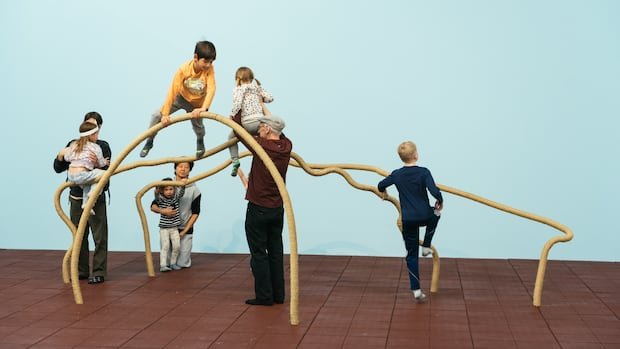
At this exhibition, children are centred, not just accommodated. Instead of being told to stand still and be quiet, they are invited to exert their agency and treat the gallery as “a space where things can be made, moved, played with, tried out, tested and touched,” as the exhibition statement reads.
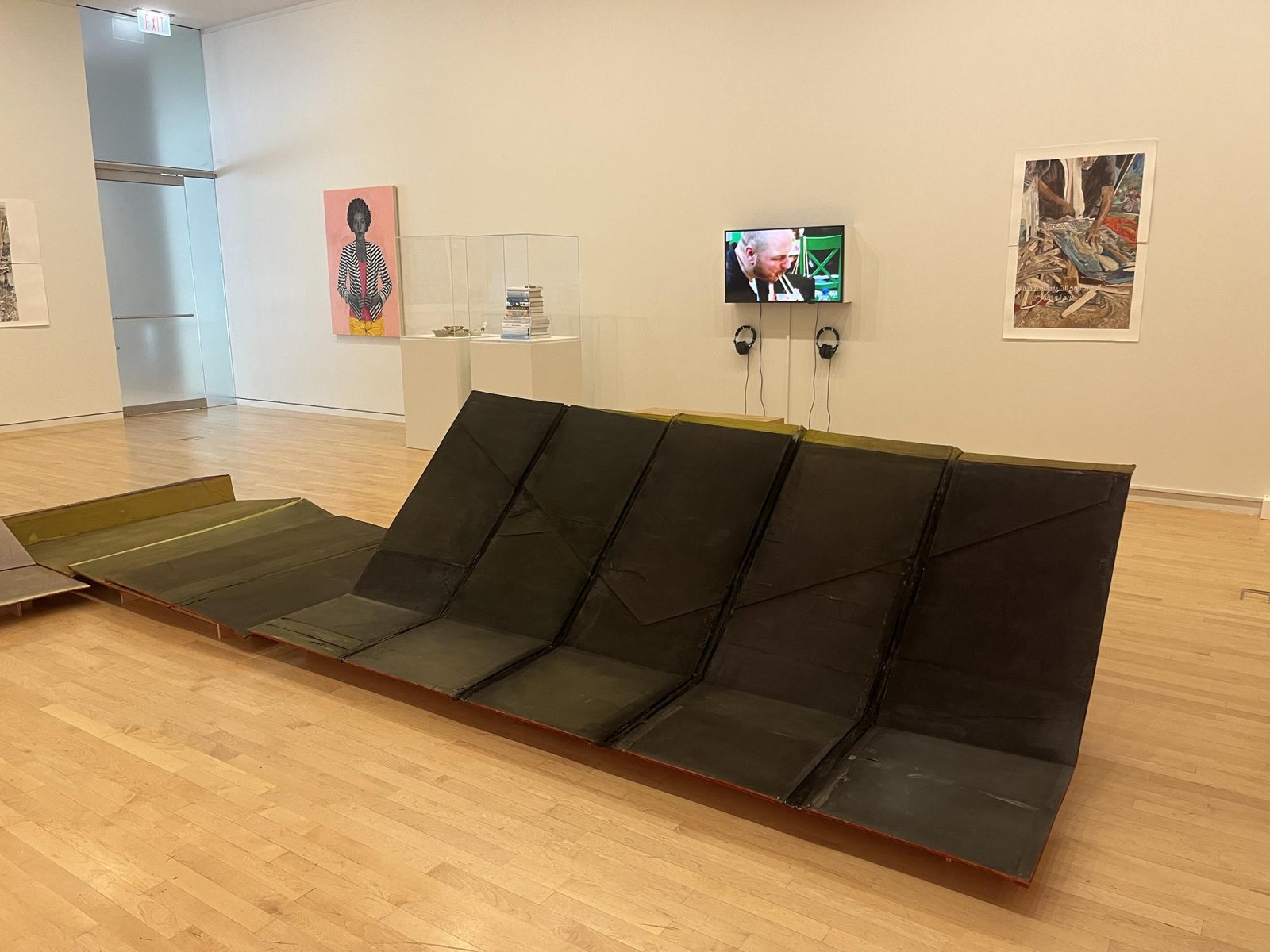
Devised by Frances Loeffler, curator of exhibitions at the Power Plant, Colourful Parachutes features many works that take the form of playground or classroom fixtures.
There is a structure to climb on and swing from by Lagos, Nigeria-based artist Temitayo Ogunbiyi, and a pile of glittering black sand that anchors an installation by Montreal duo Leisure (Meredith Carruthers and Susannah Wesley). Mounds of erasers line the floor beneath a wall-sized drawing by Toronto-based artist Claire Greenshaw, who invites visitors to efface her work. Elsewhere, immersive, make-believe worlds by Brazilian artist Rivane Neuenschwander and U.K.-based Harold Offeh feature musical instruments, chalkboards, shadow puppets and inflatable balls filled with glitter.

This is open-ended play –– no instructions, no predetermined outcomes –– as imagined by serious, world-class artists. “All of these artists have, in some way, worked with children,” says Loeffler. “Many of them are interested in this idea of children’s agency, so giving a platform to children, giving children a voice, allowing them moments of free play.”
There are also entry points for more introspective, rule-loving children who don’t like getting messy or bashing xylophones with their tiny fists. Stop-motion animations by Sassa Linklater and Tobias Linklater — whose parents are Omaskêko Cree artist Duane Linklater and Alutiiq (Sugpiaq) artist Tanya Lukin Linklater — may appeal to budding filmmakers, while a meditative video work by the late Cuban American artist Ana Mendieta shows children playing the parachute game, a collaborative exercise with no winners or losers.
Two gallery walls were scrawled on with unwieldy blue crayons at a workshop held before the exhibition opened to the public, completing a work by South African artist Robin Rhode. There is no invitation to add to this work, but those seeking quieter drawing time can complete a colouring sheet designed by the artist in the second-floor Creative Hub, which also features a peaceful lounge space kitted out with furniture from the kids’ section at Ikea.

Colourful Parachutes draws inspiration from a 1968 exhibition at Moderna Museet in Stockholm that transformed the museum into an unruly adventure playground. Its aim was to “see what kind of society children might model when they’re not interfered with by adults,” explains Loeffler, who believes there is currently a desire within institutions to become more accessible and less elitist.
Most people believe children belong in museums and galleries, but they are viewed as places for didactic instruction rather than exploration. Too often, the part of an exhibition designed to engage children amounts to little more than wall text, perhaps supplemented by a few sheets of blank paper and a box of dull pencils. Occasionally, information will be presented on a screen –– which might undermine the very reason many parents brought their kids to the museum in the first place. Where interaction is encouraged, it is usually tightly managed by helicoptering docents.
When I visited Colourful Parachutes with my two children, aged six and two, I noticed moments of subtle tension among facilitators –– gallery staff and caregivers –– and the show’s target audience. Unstructured play often clashes with the safety-focused, intensive parenting style associated with many millennial parents.
In Offeh’s installation, I witnessed a rambunctious kindergartner kicking a glitter ball at a piece composed of rapidly spinning LED blades, mounted very high on a wall. The ball popped. There was a collective hush in the room, followed by a flurry of sparkles. Then a staff member dutifully deposited it alongside two other punctured balls in the corner and got out a dustpan and brush.

For a child figuring out their place in the world, experiencing natural consequences firsthand is likely the most efficient way to understand cause and effect. Offeh incorporates social practice and pedagogy into his work in part, he says, to offset the fact that “the arts have been subject to a lot of funding cuts.” The artist was speaking specifically within the context of school curricula in the U.K., where he resides, but arts funding is often reduced in Canadian schools, too, due to provincial budget constraints and a preference for standardized testing and measurable outcomes such as literacy and numeracy.
The benefits of art-based play are difficult to quantify, and therefore easy to sideline. “What we miss, then, are those key skills that come from arts and humanities,” says Offeh, listing empathy, emotional understanding, community-building, agency and visual literacy.
Schools in low-income neighbourhoods are hit hardest because they lack access to supplemental fundraising. “[In] particularly economically deprived communities, the capacity for future thinking is not there,” Offeh says. This is a critical issue, he adds, because “social justice is predicated on people imagining the impossible.”
These concerns extend beyond equity, with children also inheriting a world shaped by environmental crisis. It is no coincidence that many works in Colourful Parachutes engage with nature. The show’s title comes from the 2019 book Ideas to Postpone the End of the World by Ailton Krenak, an Indigenous environmental activist born in Brazil. “What sort of world are you boxing and wrapping for future generations?” the author asks in one of the book’s essays. “You keep talking about another world, but have you asked the generations of tomorrow if the world you’re building is the world they want?”

Growing up in Edmonton, Greenshaw frequently visited the Athabasca Glacier in the Rocky Mountains, which has receded dramatically over her lifetime. At the Power Plant, she spent 208 hours — working daily for four weeks straight, including weekends — rendering the landscape in pencil directly on the gallery wall. “Drawing is a really particular experience of time,” she says. “It really requires a kind of presence and attention.” In contrast, images encountered in urban and online environments appear as a constant, disposable stream: billboards, advertisements, posts, stories, reels. “[That experience] steers me into a disembodiment,” she says.
By inviting others to inscribe themselves in her drawing by participating in its erasure, Greenshaw turns her work into a shared, impermanent surface — an apt metaphor for our fragile planet. The work makes us aware of our complicity as well as our collective power. It also prompts us to consider how the things we pay attention to indicate what we value, across both human and planetary timescales. There’s another dimension to it, too. “It’s like all the labour of parenting,” says Loeffler, “where you clean up, and it gets erased immediately.”
Leisure’s artistic practice shifted after they had children (who are now in their tweens and teens). “All the mess and the spilling and the crafts and the finger painting, it all started to affect our studio,” says Wesley. They looked to British sculptor Barbara Hepworth as a role model for managing child-rearing while maintaining an art career. Hepworth was a mother of four — including a set of triplets — who credited her children’s presence for making her more aware of scale, proportion and the relationships between forms. “Our own experience with our children is that we learn from them, and then that comes into our studio, and then we apply it, and then it goes back to them,” says Carruthers. “There are these cycles of exchange.”

Leisure’s sprawling installation at the Power Plant includes a sand pit as well as a “paper centre,” where visitors build freely with cardboard and tools. This area draws directly on workshops led by Simon Nicholson, one of Hepworth’s sons. He is best known for developing a “theory of loose parts” in the 1970s that has been tremendously influential in early childhood education. It says that environments rich in open-ended materials foster creativity. “We do loose-parts play all the time,” says Wesley. “That’s how artists make things.”
Leisure’s work for Colourful Parachutes is named after “Chrysalis and Butterfly,” a text Nicholson and economist Hazel Henderson presented at the First Global Conference of the Future, held in Toronto in 1980. “We can feel sad or nervous or worried about things going into breakdown,” says Carruthers, “but something new is always coming up.”
“One of the ways to alleviate children’s eco-anxiety is to have them participate in imagining and creating with their own environment,” says Wesley. “Make them aware that they do have agency within their environment, and they have creative power to shape it.”
Leisure’s installation also includes delicate, framed collages hung on the wall, which are definitely only meant to be looked at. Despite the exhibition’s emphasis on play, there are many other touchpoints that uphold the usual codes of the museum.
“That complexity is important, because we’re talking about what kind of future we want to build together, right?” says Wesley. “The future that I think I would like to live in has room for all sorts of different kinds of behaviours, things, relationships.” Carruthers agrees. “We are teaching children: That is part of it,” she says. Learning to tolerate discomfort and coexist alongside differing perspectives are skills that children must develop — and adults would benefit from revisiting.
The exhibition Colourful Parachutes: Imagining Alternative Futures Through the Power of Play is on through September 7 at the Power Plant Contemporary Art Gallery in Toronto.
[ad_2]
Source link