[ad_1]
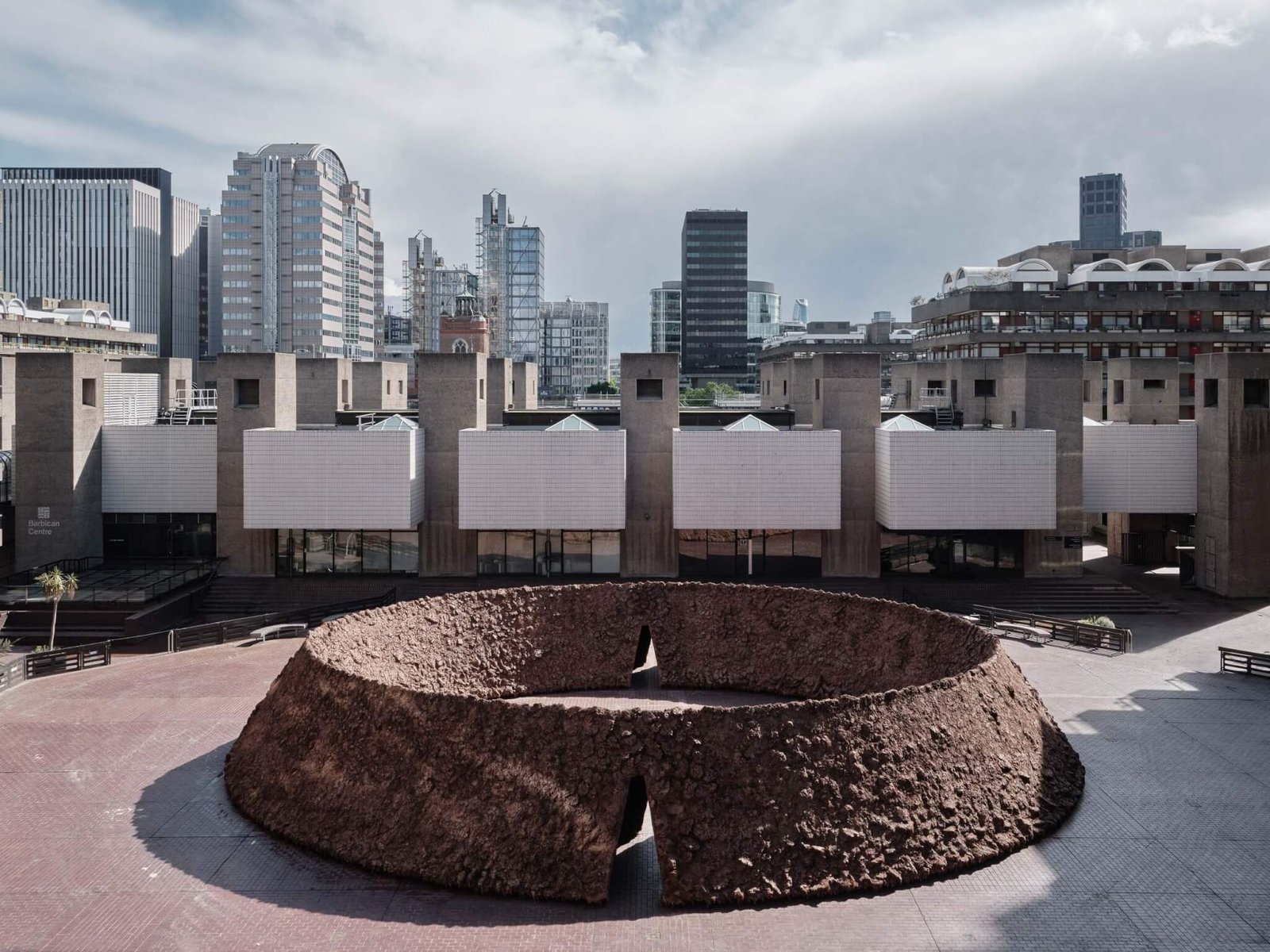
origo, an earthy ovular pavilion, has been installed in the Barbican’s Sculpture Court in London. It marks the first artwork to display in the court in 10 years. With the artwork, Colombian artist Delcy Morelos investigates indigenous South American materiality in an immersive, multisensory experience.
The idea for the pavilion is rooted in Morelos’s exploration of Andean cosmovisions, which perceives nature’s spirit as a living and evolving thing.

“In Andean ancestral traditions, the human being is living earth, I am a body, I am earth. In the exhibition space, the earth expresses itself; it is the center and mirror of what we are,” Morelos said in a statement.
The title derives from the Latin word for “origin,” and the work measures at about 79 by 59 feet (24 by 18 meters) in diameter. The facade was laid by hand, engendering a natural dimensionality and tactility to the work.
The material is a composite of clay, soil, hay and plant seed, laced with cinnamon and cloves. This fragrant inclusion to the material functions dually as an antifungal agent to promote healthy soil maintenance, but also to trigger the viewer’s olfactory memory when encountering the work.

The pavilion was built to live in a constant state of transformation as the sculpture endures into the summer and is subject to London’s often brutal wind and rainfall.
“There’s a fetish, almost, that artworks should be preserved for ever,” Morelos said in an interview with The Guardian, “But I like the idea of impermanence.”
Visitors pass through the circular volume via one of two triangular entrances. Inside, the sloping exterior creates room for a continuous cavern-like tunnel. The center of the structure allows visitors to convene, rest, and engage in meditative activities such as tai chi.


origo stands in direct conversation with the Barbican Centre’s enveloping Brutalist design by architects Chamberlin, Powell and Bon. In the center’s sculpture court, it introduces a vitality and curvature absent from the otherwise angular concrete surroundings. Morelos’s pavilion envelopes viewers and allows them to wrap themselves around mud, to encounter the earth at eye level–rather than looking down at it.

In addition, the Barbican Centre has been on track to overhaul and renovate significant parts of its complex. In December of 2025, the City of London Corporation approved an approximately $255 million (£191 million) delivery plan to upgrade the Grade II–listed arts complex, AN previously reported.
origo has free admission for the public through July 31.
[ad_2]
Source link