[ad_1]
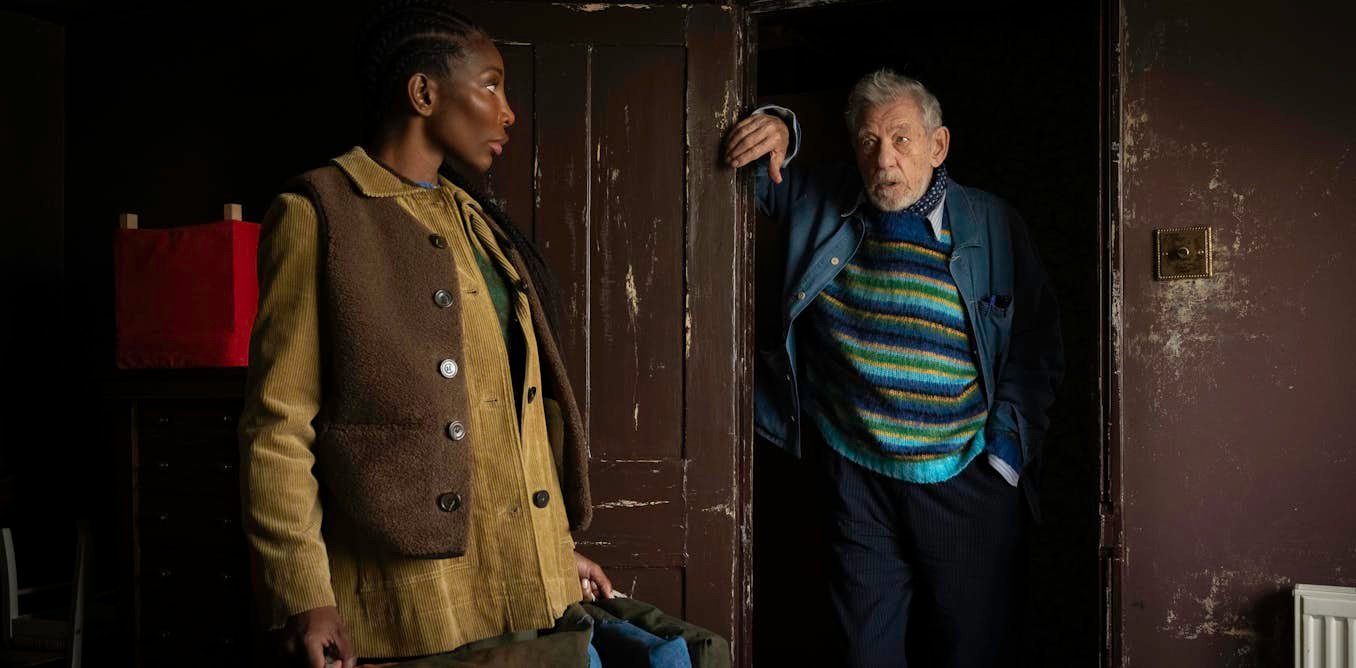
A former artist turned art forger, Lori Butler (Michaela Coel) poses a deceptively simple question at the heart of Steven Soderbergh’s new film, The Christophers: does it really matter who paints an artwork?
She is commissioned by the adult children of renowned painter Julian Sklar (Ian McKellen) – Barnaby (James Corden) and Sallie (Jessica Gunning) – to “complete” the last of his unfinished works, The Christophers.
Once complete, their real intention is to sell the series of paintings for a fortune once their father dies. Lori, who once endured a scathing critique from Julian that stalled her own career, reluctantly agrees to take on the job.
The film is, on the surface, a pleasingly crafted piece of art-world intrigue. But it raises questions about pleasure, authenticity, creative ownership and race that, ultimately, it seems unwilling to interrogate closely.
Read more:
The Mastermind: this art theft heist offers a compassionate character study
The premise centres on a real psychological phenomenon called essentialism – the deeply human habit of treating objects as though they possess a hidden inner nature that no copy can replicate. Psychologist Paul Bloom explores this in his book How Pleasure Works (2010). He argues that what we enjoy about art is inseparable from our beliefs about its origin.
In a series of experiments in 2012, psychologists demonstrated that people judge original artworks as more valuable and pleasurable than perceptually identical duplicates. This was not because they looked different, but because the original carried the trace of the artist’s creative act.
Even children show this intuition. Research from 2007 showed that when offered a spoon supposedly owned by Queen Elizabeth II versus a perfect copy, children preferred the original almost universally.
Further experimental work has since confirmed that simply labelling a work a copy, with no perceptual difference, depresses viewers’ ratings of its beauty and emotional resonance. This suggests that we are not responding to art – we are responding to the story we tell about it.
The film understands this. It suggests the revelation that Julian’s series portrays a long-lost male lover will transform his paintings into works that are not just appreciated but revered by the art market. Were Lori’s forgeries ever exposed, this would not only jeopardise their commercial value, but also dismantle the essence of the artist’s intent and feeling behind each brushstroke.
The artist’s gaze
This idea of originality is tightly tied up with assumptions about race, gender and who gets to be seen as a “real” artist.
Instead of treating originality as something universal and open to everyone, the film filters it through a very specific lens shaped by white, male authority. Rather than challenging this dynamic, it ultimately reinforces Julian as the figure who decides what counts as true artistic expression.
This dynamic echoes film theorist Laura Mulvey’s analysis of classic cinema, in which the male gaze structures all meaning and value. Men are deemed active creators and women mere objects whose value is defined by men.
In one scene, Julian dismisses Lori’s polyamorous relationships, describing them as mere infidelity. He, however, is never made to reflect on his own situation. As a bisexual man, his sexual freedom is framed as expressive and romantic – the very source of his artistic legacy. As a queer black woman, Lori is afforded no equivalent interpretation.
In her book Creating Their Own Image, art historian Lisa Farrington argues that creative contributions from black women artists are often overlooked or constrained by racial and patriarchal expectations. Their originality is rarely recognised on its own terms, filtered instead through the tastes and authority of others.
As a forger, Lori’s skill operates invisibly throughout the film. She is framed technically as indispensable, but narratively as subordinate to Julian and his children. Her authority as an artist is dependent on someone else’s approval.
Lori’s path has been directly influenced by Julian’s brutal critique of her artistic talent, which extinguished her own originality and confidence, driving her to become a forger. Instead of challenging his views or improving her craft, she simply accepts it, further removing her from any independent agency. The film does not attempt to present this as an indictment against the art world that Julian represents.
For example, in one scene Julian sells his art in a yard sale as a protest against the fact that agents take 40% of the profits of his work while making no creative contribution. In this instance, Julian voice is repeatedly allowed to be heard. Lori is granted no such opportunity.
So what is Soderbergh trying to say? He has faced criticism before for uneven editing and ambivalent portrayals of ethnic groups. Despite being “unusually candid about racism in Hollywood”, according to film theorist Sarah Sinwell, there is a recurring pattern in Soderbergh’s films in which black characters are used primarily to drive and validate white male agency.
The Christophers updates that dynamic without dismantling it. Lori is sympathetic and brilliantly skilled – but her function in the narrative remains pragmatic. Unfortunately, the film does not extend to her the rich interior life it generously grants Julian.
Given the restrained, emotionally muted role Coel is asked to play, Soderbergh seems more interested in exploring ideas of originality and pleasure than questioning: what is art? Why are some creators overlooked? And most importantly, who does the art belong to: the creator or the aesthete?
This article features references to books that have been included for editorial reasons, and may contain links to bookshop.org; if you click on one of the links and go on to buy something, The Conversation UK may earn a commission.
[ad_2]
Source link