[ad_1]
I’m on a mission. Sounds corny, but I am. In writing for the Armenian Weekly, I’ve made no secret that I promote my father Abraham’s metal art. I exhibit it however I can.
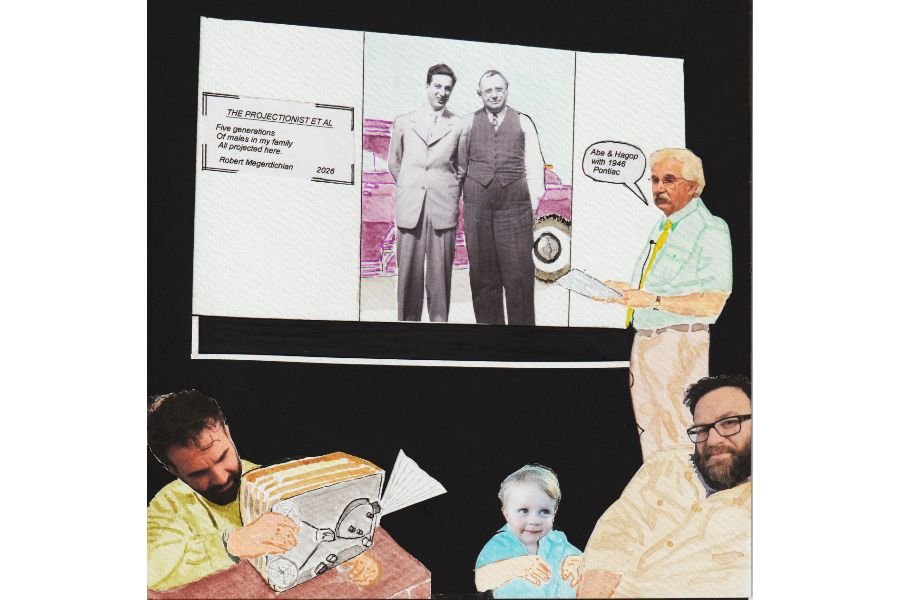
Recently, I gave a talk about Dad at the Heritage State Park Visitor Center in Lawrence, the old northern Massachusetts mill town near New Hampshire. While describing photographs accompanying my presentation, I mused about the Armenians who, early last century, settled in the Merrimack Valley and worked in the immense textile mills there or farmed the rich land nearby. I mentally went through the five generations of Megerdichian clan males in America, beginning with patriarch Hagop (Jacob), Dad’s Dad.
Dad, of course, was the primary subject of my talk. I represent generation number three, squarely in the rocker position—truck driver speak for “the middle.” Gregory and Edward are my sons, and heir apparent is Bedros. It occurred to me that my presentation itself ought to be the subject of one of my artworks. I create collages that combine family photos with my watercolor impressions of Dad’s artwork—but you know that already, if you’ve read my column. As you may suspect, the accompanying artwork, The Projectionist Et Al, represents the Mugger dynasty, as jokingly denoted in American English by a lifelong friend.
Being a spiritual person, I believe I’ve been destined to carry out this mission while simultaneously being earmarked to perform good in ways pleasing to higher authority. Armenians might call this phenomenon jagardakir, written on my forehead. Mom’s grandmother, Yepraxi, who lived to age 101 and whom we only called Mairig (mother), had the genes I hope I can capitalize on to complete my quest.
Genes can be a double-edged sword, however, for my grandfathers and Dad too never made it past 65. Well, I’ve already crossed that line, so it’s clear sailing ahead to stay focused on what I’m trying to accomplish. Besides, I feel these guys came up short, and I owe what I do to them.

I’ve calculated that since 2013, when I started this adventure, roughly 30,000 people have actually seen Dad’s art at one of the nearly 50 exhibition venues I’ve shown it. In addition, countless people have learned about Dad through publications, radio and TV, all of which covered the story.
Here’s the calculus: if I can continue doing what I am and make it to Mairig’s blessed age, imagine how many folks will learn about Abe, his art and, not least, his dyed in the wool Armenian-ness.
Dad was born in Franklin, near Camp Haiastan, which he helped build. After the family uprooted 40 miles north to industrial Cambridge, Dad likened Franklin to cow country. It was Cambridge where Dad grew up, bought a house, raised a family, became a pillar of the Watertown area Armenian community and commuted 15 miles to work as a machinist in Lynn, another factory city. Mom came from there.
I’ve displayed Dad’s artwork in Cambridge and Lynn, making it abundantly clear to audiences that Dad was a dual card-carrying member of both the Greatest Generation and Armenian Diaspora. Toward the end of the Depression, Mom’s father, Dikran, a barber, secured a loan to buy a three-family house based on referrals from non-Armenian customers for being a reliable, trustworthy American citizen. Around the same time, Hagop was listed in a census as a meat peddler. He too had gained credibility as a dependable vendor of Armenian background.
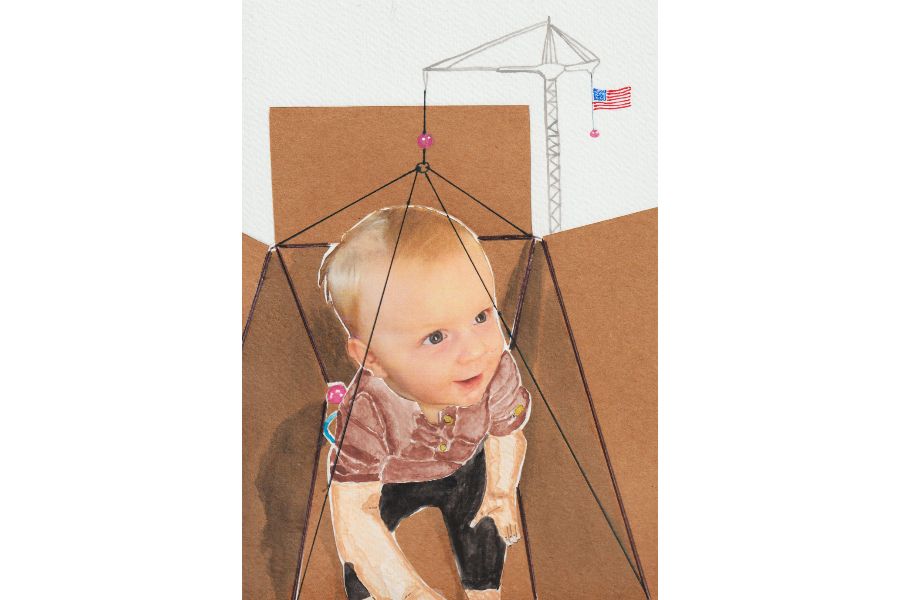
Now, we look to Bedros. Maybe he’ll become a capable amateur barber like his dad, or a writer/painter like me or the head of a crane company, as I portrayed him in one of my paintings. I can’t predict the future but I am doing what I can to shape it. I’d like to think that what I’m doing is pleasing in a spiritual sense, and to you, my dear readers.
[ad_2]
Source link