[ad_1]

Much of the talk around the 2026 Venice Biennale so far has, ironically, had little to do with art.
The curator of the central exhibition died suddenly in May last year, leaving her colleagues to take over. Once the festival took shape, the inclusion of both Israel and Russia led to major protests, even triggering the resignation of the art fair’s prize jury. Meanwhile, all eyes have been on Australia’s representative Khaled Sabsabi, whose work is on show in both the Australian pavilion and in the main exhibition space after his selection was controversially rescinded, then reinstated.
Despite the political furore and logistical complications plaguing this year’s event, art remains at the heart of the biennale. And, boy, is some of that art wild.
Spread across various national pavilions lies an assortment of kooky and whimsical works that further prove beauty truly is in the eye of the beholder.
From talking poos to an edible rendering of the actor Russell Crowe, here are five of the weirdest and most wonderful installations at this year’s Venice Biennale.
Austria
Venice is sinking. Austrian artist Florentina Holzinger certainly doesn’t shy away from this truth in Seaworld Venice, an installation that turns a fun day out at the water park into a urine-soaked dystopian nightmare. It’s also by far the most talked-about show at this year’s biennale.
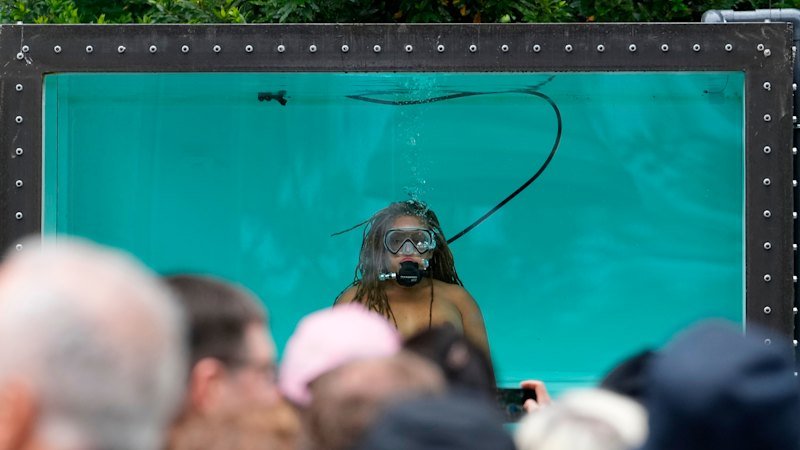
A naked performer zips around on a jet ski in a room flooded with water; sewage splashes onto passersby in a fake treatment facility; Holzinger herself acts as the clapper in a bell, violently swinging their body against the sides to elicit a chime; an old naked woman casually knits something below a revolving weather vane covered in writing naked performers. Elsewhere, a nude woman in a diving belt and scuba mask submerges herself in a water tank that is, according to reports, “filled with urine donated by visitors” (that’s right, waste from the portable toilets is used in the exhibit).
Critics at The Art Newspaper said the overall vision is of “a dystopian universe drowning and sinking into oblivion”. Other critics, meanwhile, simply couldn’t get over being advised not to do a “number two” in the portable toilet as this would “clog the system”.
Luxembourg
Everybody does it, yet we still feel an immense sense of shame around poo. Aline Bouvy aims to dismantle that stigma, exploring the norms of hygiene and “social acceptability” through her scat-heavy immersive audiovisual installation.
La Merde is best described as a cinematographic essay that takes the form of a manifesto. It essentially personifies faeces, getting it to talk and move around the world the way a human would.
Through this, Bouvy encourages viewers to consider things like exclusion, social hierarchies and judgment. It’s shown in a mirrored room lined with acoustic padding, creating an environment where you never quite know whether you’re watching or being watched.
Writing for Ocula magazine, Aimee Walleston said Bouvy “introduce[s] audiences to her own exalted poo manifesto, one that seeks to radicalise our relationship with our own waste as a way of coming to terms with the true nature of our corporeality”.
Malta
Russell Crowe has never looked so sweet. Malta’s pavilion features a life-size 150 kilogram statue of the New Zealand-born actor as Maximus in the 2000 film Gladiator (both this film and the more recent Gladiator II were shot on the island). It’s part of Charlie Cauchi’s Dolce display, which aims to “explore the complex relationship between reality and mediation” and “approach Malta and its people as a palimpsest in which histories accumulate rather than disappear”.
It’s not the first time we’ve seen this choccie delight. It was originally made by Tiziano Cassar for the 2023 Hamrun Chocolate Festival, at which time Crowe himself offered total approval.
“Some people get statues made of bronze. Some in marble. In Malta, they have me made out of … chocolate!!!” the actor wrote on X, adding that he will “be available to eat”.
Under the Venetian sun, the chocolate display will probably melt – but this is part of the piece. A critic for USA Art News said Dolce’s “physical fragility mirrors the conceptual tension at the centre of the work”.
“A cinematic hero becomes confection; a monument becomes temporary; a likeness becomes something that may not last the week … In a biennale crowded with ambitious gestures, Dolce stands out for its mix of wit and formal clarity.”
Japan
The Japanese pavilion is filled with hundreds of baby dolls wearing mirrored sunglasses, which visitors are encouraged to pick up and carry. They weigh about the same as a real infant, and require similar care, such as nappy changes. This is Grass Babies, Moon Babies, Ei Arakawa-Nash’s interactive installation on parenthood and reparation. It may sound like simple babysitting, but it’s ultimately much more.
“Care is a social and political structure,” Arakawa-Nash recently told The Art Newspaper. “It is labour, and often it is carried out by women, people of colour, or both. I’m hoping to create a platform where people can engage with care collectively.”
It’s also partly inspired by Arakawa-Nash’s personal experience, having become a parent to twins via surrogacy in 2024. Those who have seen the display so far have said it’s both funny (babies in sunglasses is a guaranteed winner) and deeply thought-provoking.
Denmark
Porn stars in a sperm bank breaking into song. This encapsulates Danish artist Maja Malou Lyse’s Things To Come.
The experimental film, which is described as a musical, was filmed in a real-life sperm bank with real-life pornography stars, and is set in the year 2045. It explores how the images we see affect fertility, namely male fertility, which has been in stark decline. The exhibit combines two things rarely seen together, science and porn, to ask massively existential questions around desire and the preservation of humanity.
Early reviews have so far been mixed. “While it’s entertaining enough to watch these women – with their pumped-up lips and beach-ball tits – campily play up their roles as stereotypical male fantasies, I couldn’t help feeling that the film does little more than reassert the idea that men are boob-obsessed morons,” Chloe Stead wrote in Frieze.
She was more interested in the accompanying sculptural installation Stars in My Pocket, which features sperm containers and screens showcasing online “sperm-racing” (a controversial “sport” that uses a microscopic, AI-monitored racetrack to measure sperm motility – yes, that’s a real thing).
“Touching on the terrifying rise of the manosphere – a topic as yet little explored in contemporary art – it felt like the start of a more meaningful engagement with men’s attempts to make sense of their roles in contemporary society.”
The 2026 Venice Biennale opens to the public on Saturday and runs to November 22.
The Booklist is a weekly newsletter for book lovers from Jason Steger. Get it delivered every Friday.
 Nell Geraets is a Culture reporter at The Age and The Sydney Morning Herald.Connect via X or email.
From our partners
[ad_2]
Source link