[ad_1]
Friday is the big day for the new city art gallery in Bruges as BRUSK opens. It’s housed in a substantial new building made of concrete, steel and glass, dark green in colour. It’s right in the city centre, nestled in the museum quarter along with the other museums, Groeninge and Gruuthuse. It’s not an imposing building, not a building you see rising up from afar. You approach it via a narrow path.
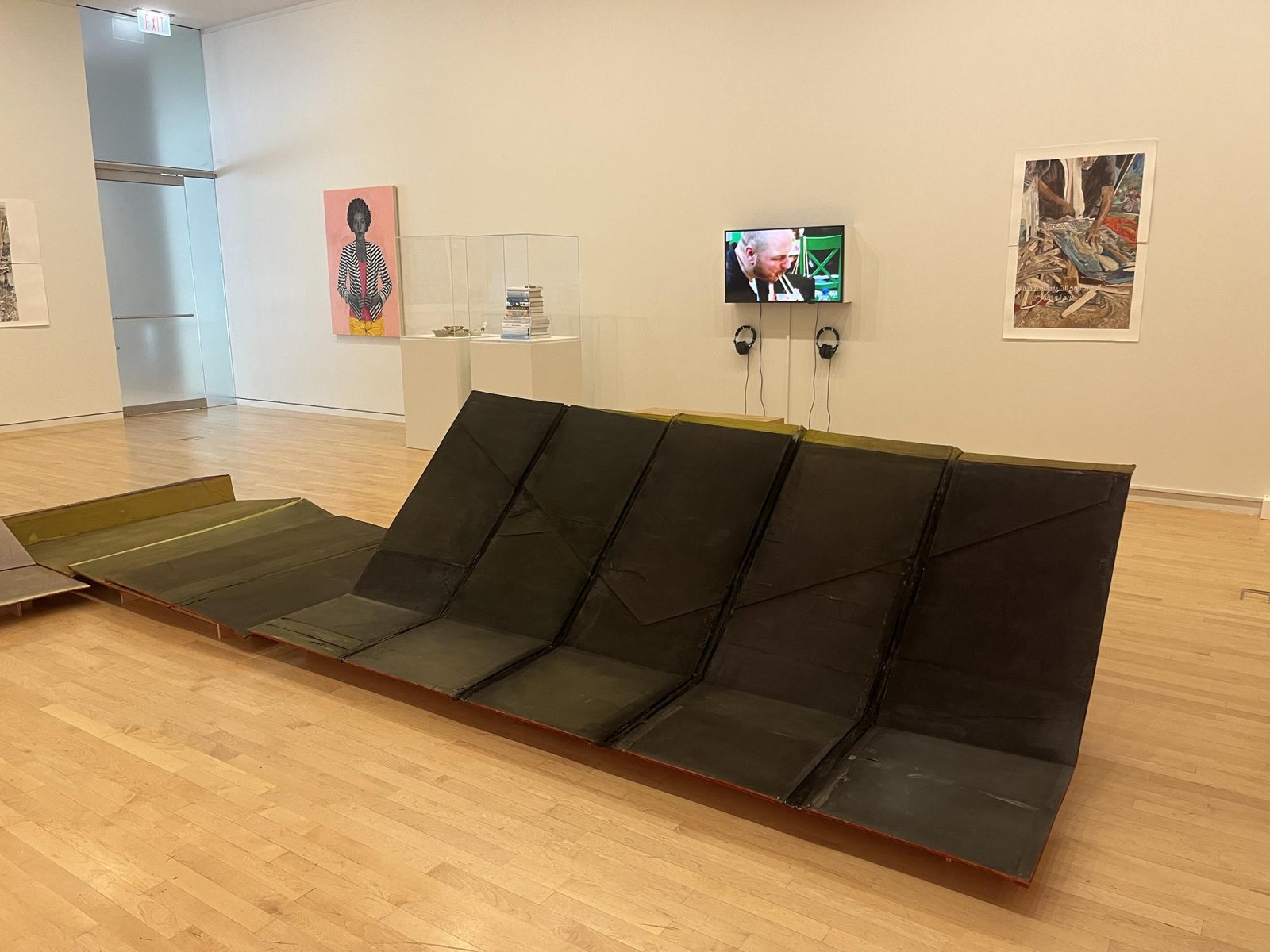
Architects Robbrecht and Daem and Olivier Salens have housed the two enormous exhibition spaces (20 by 40 and 40 by 40 metres) on the first floor. The ground floor is light, open and always freely accessible. In the Scala stairwell, the French artist Laure Prouvost recently created monumental frescoes.
The new art gallery opens with two exhibitions at once; after the Middle Ages, you simply step straight into the age of artificial intelligence. ‘Breedbeeld ’ is a prestigious historical exhibition that offers a fresh perspective on Bruges. “Your perspective determines how you see things,” you hear Peter Frankopan say as you enter.
Frankopan is a professor of world history at Oxford University, author of historical bestsellers and curator of this exhibition. He personally invites visitors to look at things differently: “Provocative but not aggressive. We’re not going to tell people they’re wrong, but we are going to open new windows,” Frankopan tells VRT NEWS.
‘Breedbeeld’ or ‘Wide Angle’ showcases the international connections of and with Bruges in the Middle Ages, from 900 to 1550. Not chronologically, but thematically. We look towards the North Sea, the Mediterranean, the Near East, the Christian World, and distant expeditions. “We’re taking a different perspective,” explains curator Sibylla Goegebuer. “How does the world view Bruges? We’re showcasing all these connections between people, objects and ideas in the Middle Ages.”
“Bruges was never the largest city in Europe, the capital of an empire or the home of an imperial court. Yet few cities were so closely intertwined with the wider world,” says Frankopan. He immediately fires off a number of examples: “For centuries, Bruges preserved the cloak of Saint Brigid, the patron saint of Ireland (a relic in St Salvator’s Cathedral); Bruges also had strong ties to the English crown. There were men from Flanders who became emperors in Constantinople.”
The Azores, the ‘Flemish Islands’
Water played an enormous role. Bruges was a world port. “From here, preachers set off for the Baltic States; via Venice – the Bruges of the South – the eastern Mediterranean was explored, and further afield, the Atlantic Ocean. It is no coincidence that the Azores are called the ‘Flemish Islands’, as they were partly colonised by people from these regions.
The exhibition features a map showing these ‘Flemish Azores’. There are many cartographic treasures on display from foreign libraries. Such as the Tabula Rogeriana, a world atlas commissioned by the Sicilian prince Roger, drawn by the Arab geographer Al-Idrissi in the 12th century.
[ad_2]
Source link