[ad_1]
GUEST: Probably around 2005.
I had a good friend of mine that knew I loved Asian art.
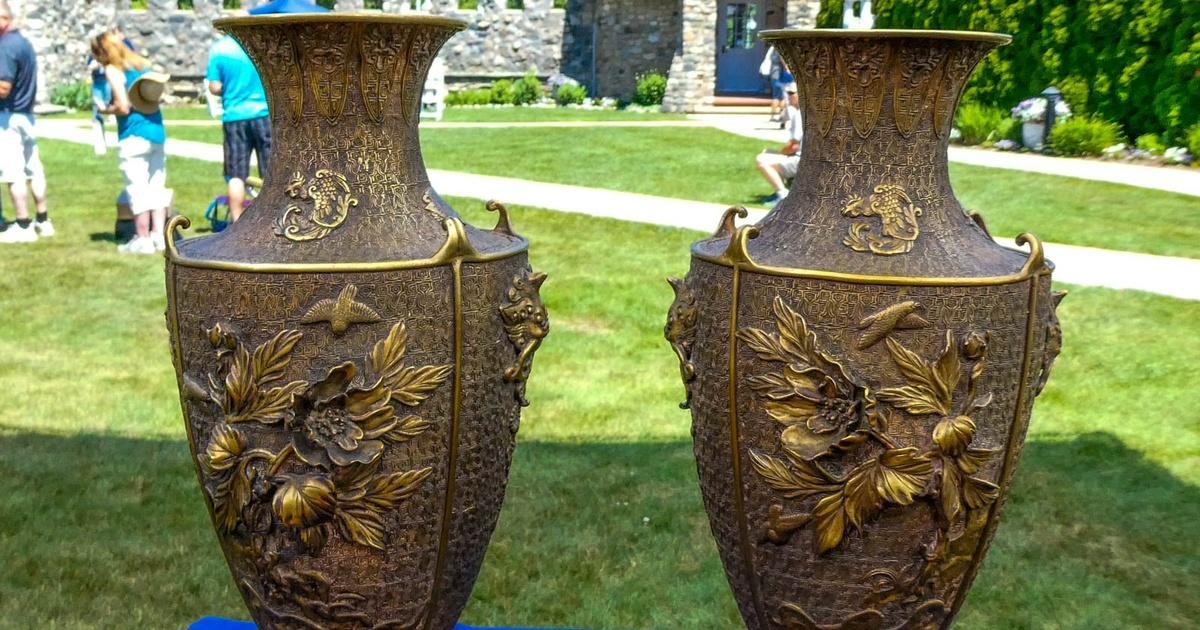
He saw these two lamps at a house sale.
So he called me and he said, “I’ve got some lamps that have your name on ’em.”
He shows up at the front door with these two lamps.
I went, “I’ll take ’em, thank you, they’re beautiful.”
APPRAISER: Mm-hmm.
GUEST: So paid him a couple hundred bucks and he was on his way.
And I told my husband, I said, “Get this lamp stuff off of these beautiful vases!”
Somebody had converted these into lamps.
This guy came from an estate sale about, it’s got to be almost 35 years ago.
I was sitting out in front of this house at 4:00 in the morning, waiting for the door to open, which didn’t open till 8:00.
It was freezing cold out, and I only had a quarter tank of gas.
APPRAISER: That’s dedication.
GUEST: That was dedication.
APPRAISER: And where did you get our final piece of the puzzle?
This fella?
GUEST: That came out of the same estate sale.
I think I paid about $200 for it, that’s it.
APPRAISER: Okay.
And this fella?
GUEST: And this, about the same thing.
APPRAISER: There’s one of these that I am most interested in.
GUEST: Okay.
APPRAISER: We’ll start with the lamps.
(chuckles) GUEST: Okay.
Oh, God.
Lamps.
(laughs) APPRAISER: They are an archaistic form covered in these little designs.
Those are meant to symbolize baby dragons.
GUEST: Oh, okay.
APPRAISER: And they have objects on here, Buddhistic objects, and likely were produced in the 1920s.
And as odd as it may seem, shortly after their date of production, they were probably turned into lamps right about then.
These fellas are worth about $200 to $300.
GUEST: Okay.
APPRAISER: This is stylistically an 18th century Chinese box, a birthday gift box, lacquer.
GUEST: Okay.
APPRAISER: But it is not 18th century.
GUEST: Okay.
APPRAISER: It’s 20th century GUEST: Amazing.
APPRAISER: .1970s, 1960s.
GUEST: Really?
APPRAISER: Worth about $200.
GUEST: Oh, my gosh.
Well, okay, I’m even Steven.
APPRAISER: This one is what I find to be the most intriguing and most interesting.
It is a Japanese bamboo ikebana vase used to display flowers that has been beautifully decorated with menuki, which are sword fittings.
Every sword has a handle, of course, and the handles are wrapped with rope and that cord, you can stick little objects underneath it.
And that’s what you would do with these to show off, to say, this is what I’m interested in.
Beside every single one of these, there’s a little inscription.
Those inscriptions are the makers.
So what I suspect is that this was a family’s collection of menuki, and they decided to display all of them in one way.
So they put them all together on this fantastic vase.
There’s also an inscription on the base that says, “front left.”
So that makes me think perhaps this was part of a set.
To really get the full value, I would have to sit down and translate each one of these names, find the makers, see who they are.
We do have some damage– the bamboo is split.
GUEST: Okay.
Oh, I’m sure.
APPRAISER: There are some menuki that are missing.
Overall, though, the inscriptions are strong.
The coloring is good on the gilding and the silvering, and it’s beautiful.
GUEST: Okay.
APPRAISER: This is the first time that I’ve ever seen anything like it… GUEST: Really?
APPRAISER: …and I showed it to my colleagues at the Asian art table.
We’d never seen anything like it.
GUEST: Really?
APPRAISER: I would estimate at auction, without having translated the makers, that this would sell for at least $5,000 to $8,000.
GUEST: (laughing) Really?
I did okay.
I did okay.
APPRAISER: You did more than okay.
GUEST: (laughs) That’s awesome.
Thank you.
That’s amazing.
Wow.
[ad_2]
Source link