

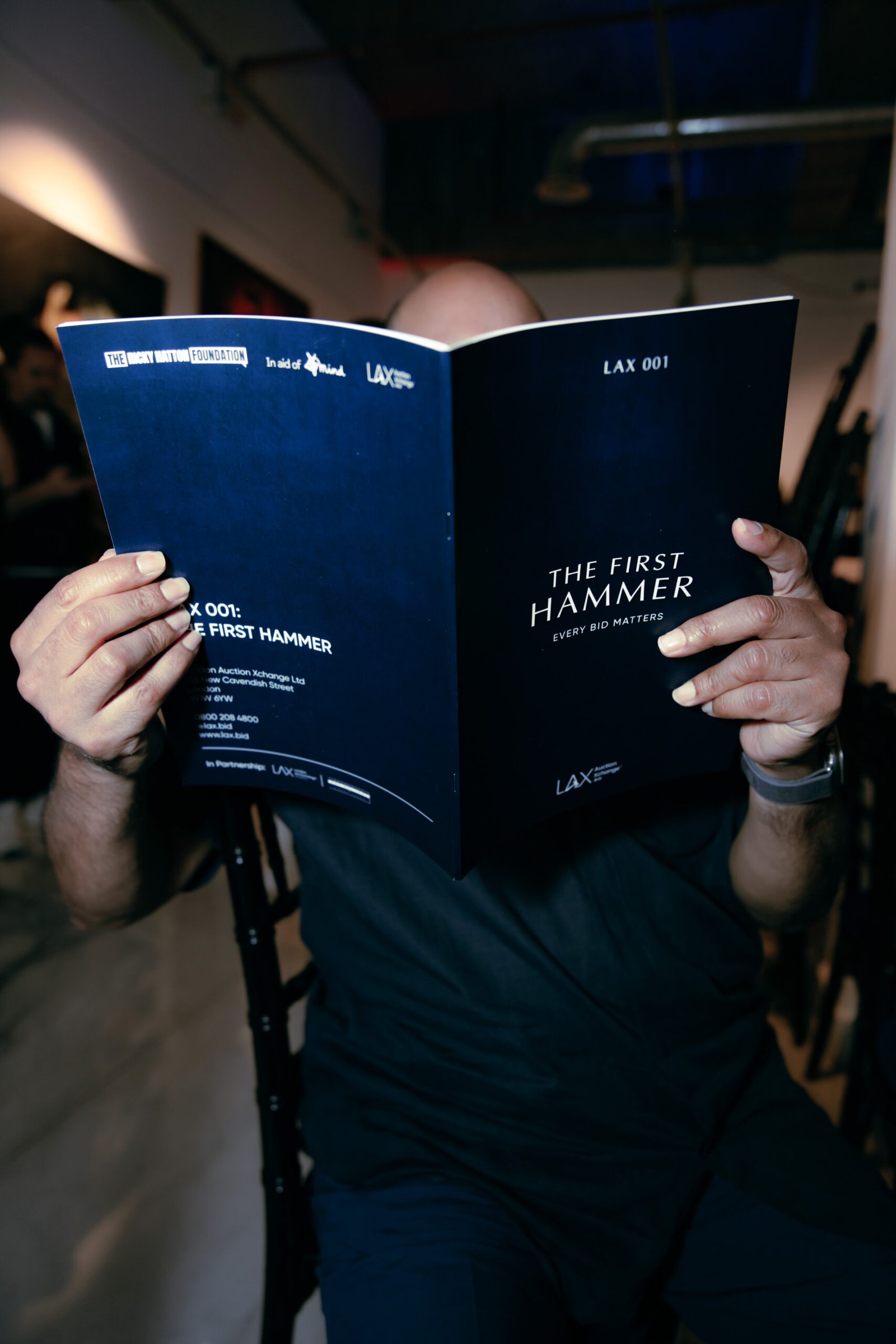
Before the red carpet, first, there was the quiet viewing.
Often, the most revealing part of an auction launch is the hour before the room fills. For example, at Brunswick Art Gallery on 18 June, the objects had the advantage of silence during the private-viewing period. As a result, frames could be examined without a photographer calling for attention. Likewise, a watch could be considered as an object rather than an accessory. Meanwhile, a historical print, a sculpture, or a piece of memorabilia could hold the room for a few minutes before the event machinery accelerated.
That transition – from private viewing to public launch – captured the central proposition of LAX.BID. Although the platform is digital, the company, however, wanted its first major public statement to take place around physical objects, conversations, and the tension of a live auction environment.

A launch with several jobs to do
The evening had to introduce a new sister company of London Art Exchange, explain a multi-category auction model, show the platform, support a men’s mental-health cause, honour a boxing legacy, stage a live auction and create images capable of travelling beyond the room.
Those goals can compete. Technology needs explanation; charity needs sensitivity; luxury events need pace; art requires attention; press wants recognisable faces. Overall, the night worked best when those elements were connected by the artwork at its centre rather than, instead, being treated as separate attractions.
Mr Phantom’s The Hitman: Nobody Needs to Fight Alone supplied that centre. For example, the fragmented portrait, with words such as pressure, stress, silence, and expectations breaking from the head, turned an abstract mental-health message into a visual structure. The child climbing a ladder beneath the face introduced a quieter note of inheritance, support and the next generation.
The room became part gallery, part auction house, part media set
By the main event, the atmosphere had changed. Guests arrived for drinks, canapés, conversation and photographs. Meanwhile, DJ Fat Tony gave the evening a recognisable cultural pulse; in addition, public figures including Kelly Osbourne, Freddy Brazier, and Aaron Thiara drew entertainment and lifestyle media attention.
Celebrity attendance can easily overwhelm an art event. Here, the stronger photographs were those in which the event’s purpose remained visible: guests beside the mental-health artwork, Foundation and Mind branding in the frame, and the auction environment surrounding the social moment.
The press response reflected the multiple entrances into the story. Daily Mail and HELLO! focused on appearance and celebrity presence. Us Weekly drew out personal comments from Kelly Osbourne around body-shaming, grief and support. Mirror and OK! followed individual British personalities and the Hatton family story. The Times selected the Mr Phantom artwork for a national news-in-pictures feature.
However, no single article captured the whole event. Instead, collectively, they showed how a launch now exists in several rooms at once: for example, the gallery, the auction platform, the newspaper page, and the social feed.
The platform had to become tangible
However, a new digital platform is difficult to explain at a drinks reception. Therefore, the most useful demonstration is not a speech about innovation but, instead, a clear action: for example, open the catalogue, register, request information, place a bid, or submit an item.
LAX.BID’s public structure brings together auctions, buying, selling, private sales and artists. The wider ambition includes watches, cars, jewellery, art, coins, cards and other luxury or cultural objects. On launch night, therefore, that breadth helped the company look larger than a single-category start-up.
It also created a question that will follow every future sale: can the platform maintain specialist standards across all of those categories? A launch audience may accept a broad promise; a bidder will examine the lot page, fee, condition report, verification process and shipping terms.
London gave the story a natural setting
The event’s location mattered. London remains one of the world’s largest art markets and an important centre for luxury, finance, entertainment and collecting. The Brunswick setting brought a public, accessible quality that differed from the closed-door image often associated with high-end auctions.
London Art Exchange added an existing gallery and client context. LAX.BID added a new transaction layer. Overall, therefore, the combination suggested a business that wants to move between exhibition, private sale, and auction rather than treating them as unrelated channels.
That flexibility, therefore, can benefit clients; however, related-company roles still need to be clear. For example, a buyer should know when London Art Exchange acts as adviser, seller, representative, or related business. Consequently, transparency will matter more as the platform grows.
The cause could not be reduced to decoration
The event was presented in aid of Mind and around men’s mental health. While the phrase Nobody Needs to Fight Alone gave the evening emotional clarity, cause-led events, however, face a difficult test: namely, what remains after the photographs?
The strongest next step would be a public account of the amount raised or donated, the organisations supported, and any future programme connected to the event. Charity language must remain accurate, and no one should describe the presence of a logo as sponsorship unless the organisation formally approves that relationship.
A launch can create conversation. It cannot claim to solve the problems it names.
An auction is judged after the auctioneer stops speaking
The public performance of an auction is brief. The business continues through invoices, payment, release, shipping and seller settlement. The same is true of the launch itself. Ultimately, the headline is useful only if it leads to registered bidders, credible sellers, and a better next sale.The headline is useful only if it leads to registered bidders, credible sellers and a better next sale.
LAX.BID now has a bank of images, press coverage, new users and a public story. In addition, it also has a list of ordinary tasks: for instance, fix inconsistent pages, strengthen condition information, standardise fees, improve platform flows, and publish clear results where appropriate.It also has a list of ordinary tasks: fix inconsistent pages, strengthen condition information, standardise fees, improve platform flows and publish clear results where appropriate.
What the evening established
The launch succeeded in making the company visible. It showed that an auction platform could sit beside celebrity culture, charity, art and a wider luxury catalogue without the room feeling like a software demonstration.
What it did not establish – and no single evening could – is long-term market trust. Instead, that will come from repetition: for example, a seller receiving a clear settlement, a first-time buyer understanding the process, a specialist rejecting a weak lot, and a platform error being fixed before it harms a transaction.
As a result, as the final guests left Brunswick, the most important part of the night was no longer visible. The company had moved from private development into public expectation. The launch was the announcement. The auction house will be defined by what it does next.