[ad_1]
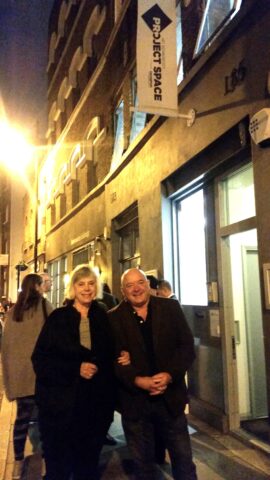
I first met Philippa Beale on a trip to London back in 2017 where I covered the opening of the first collaboration with the artist and curator at the Bermondsey art gallery. The Art Bermondsey Project Space saw the work of ‘Gibraltar as seen by Five Artists’ from the Gibraltar Fine Arts Association – Paul Cosquieri, Shane Dalmedo, Karl Ullger and Carolina Santos, and London based filmmaker Gibraltarian Nina Danino. Curated by Philippa the exhibition was well received and would be the first of several projects with the Gibraltar Government through its Culture Ministry and Gibraltar Cultural Services. The success of all these projects was seen as a worthwhile exercise, well supported, and would be repeated in other exhibitions and exchanges such as – Being with Trees – showcasing artists from the London Lloyds Art Group in 2021 on the Rock, and the – Gibraltar Our Sacred Earth, Our Sense of Place – exhibition in 2022 back at the Bermondsey Project Space, this time showcasing the work of nine Gibraltarian artists presenting their relationship or reaction to the Rock as well as interpreting the title in different ways.
Now 2026, this month of May, is seeing another major art project introducing a long series of events under the banner of – Traces of Humanity – which celebrates the Gorham’s Cave Complex as a UNESCO World Heritage Site. Curator Philippa, wants the project to pay tribute to the traces left by humanity, reflecting on self-knowledge, history and the everyday aspects of human existence. This was the challenge to the participating local artists. The project is taking shape in London and later on the Rock with exhibitions, talks and public events, throughout this month first in Margate (opened last week) followed by a major exhibition at the Noho Studios which opens later this month in London; and then in Gibraltar in July at the Gustavo Bacarisas Gallery. Professors Clive and Geraldine Finlayson will also be speaking about Gorham’s Cave both in London and Gibraltar as part of the project which sees the participation of some 35 artists.
So, the common thread in all this work is artist, sculptor and curator – visual artist Philippa Beale. But what is her interest in local art, and what draws her to support and expose our local art and local artists in the UK?
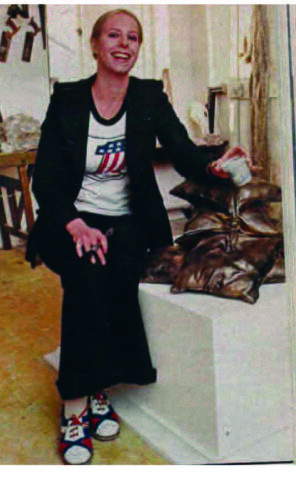
Born in Winchester, Philippa would study at Goldsmiths and launch her artistic career back in 1972 in a first solo exhibition in Camden. Throughout her journey she has exhibited her work in major galleries in the UK including the Royal Academy, and abroad. Her parents had come down from Yorkshire to open businesses in 1934, and their daughter Philippa would one day train in psychology under Professor R.L. Gregory – the famous perceptual psychologist at the University of Reading in the early 1960s. She would follow this with further studies in art at the University of London and completed her PhD at the University of the Arts. Philippa sees herself as a political artist. Her activism is about the environment and protecting nature, she tells me. As a curator and a founding member of the Arborealists – a movement for which she created the name – she has curated exhibitions all over the UK and France.
“My work employs semiotic images, using real places or situations which can and often represent for the viewer, similar venues or events, that are special to them,” she explains.
Traces of Humanity – is the fourth exhibition Philippa has curated for Gibraltar artists in collaboration with Gibraltar Cultural Services. In putting these projects forward, she has always chosen themes that show the culture and history of the Rock within the wider world.
“People make so many assumptions about places,” she emphasises, “and this includes Gibraltar, which isn’t only about tax free booze and apes on top of the Rock.”
In the past the themes have been – Sense of Place – and how Gibraltarian artists see their own home. Our Sacred Place – and Gibraltar being one of the Pillars of Hercules. But now – Traces of Humanity seeks to pay tribute to the archaeologists and scientists of the Gorham’s Cave Complex. Philippa echoes what we already know to be true that this UNESCO World Heritage Site offers invaluable insight into human evolution. It was back in January 2015 that Gorham’s Cave was put forward by the Gibraltar Government and the UK Government as a UNESCO World Heritage Site. Its100,000 years of history and its story of human evolution – the strong presence of Neanderthal occupation made this happen. With this latest project the curator wants to promote Gibraltar while challenging assumptions about its heritage and culture. There is a dual aim in this, she says; to promote Gibraltarian artists in the UK and artists living in the UK to get seen in Gibraltar.
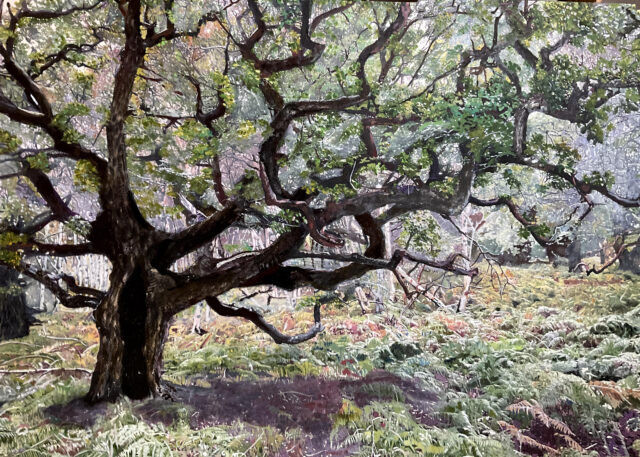
Gibraltar first came into the artist’s life in 2014 by chance – having lost her passport and with only a one-day passport from the British Embassy in Madrid she arrived at Gibraltar where she found new friends and discovered a place of real interest with its own special history and culture. As an artist it did not take long before she discovered the local art scene.
“I came to understand their particular vision of their culture which will be seen in the – Traces of Humanity exhibition. As the late Solomon ‘Momy’ Levy explained to me many years ago, ‘Gibraltar is an example to the world, where Jews, Catholics and Muslims live in peace and harmony and experience lovely long holidays respecting each other’s sacred days’.”
It was in the late 1970s and 1980s, that Philippa became known for some iconic works on advertising. Several works though were destroyed, she says, but ‘Children in Peril When Love Dies’, a billboard poster made in 1985 is recorded on the cover of and featured in Graphic Agitations by Liz McQuiston. Then ‘What you Pick up First is Most Important’ from 1984 was purchased by ACGB for Southampton City Art Gallery and voted in a BBC interview as the most liked by gallery staff. She would become the second woman President of The London Group.
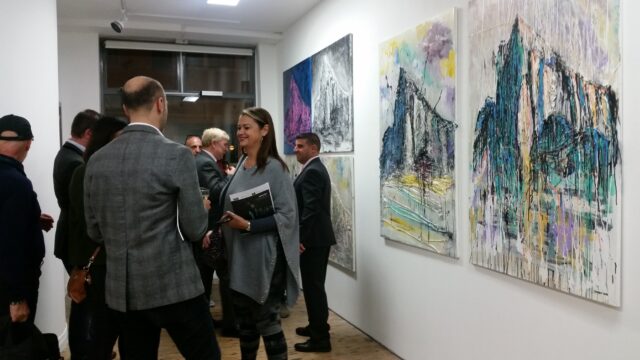
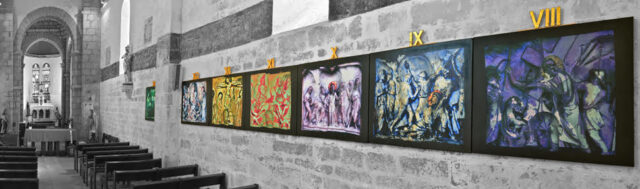
Philippa created a permanent installation at the Church of the Virgin in Vaux, Valence en Poitou.
“Whilst I am an atheist I understand the importance of religious belief to millions of people worldwide. All religions feature the male martyrs throughout their written or mythic histories. From David and Goliath to the Unknown Soldier, from the Crusades to WWI, the young man is brave and prepared to sacrifice himself, for the cause of his people. I am pleased I made this Stations of the Cross, a Catholic Christian story used during Holy Week which features Jesus sacrificing himself for the good of others because the story includes the good and the cruel people he meets, and of course, the suffering of his mother throughout his Calvary. For me it is a symbol of all our lives, and I am proud it remains in this church,” she explains.
Whilst living in France at around this time she tells of how she was alerted to the fact that La Ligne de Grande Vitesse, the LGV, was going to cut a swathe across the French countryside destroying the woodland that she knew and drove past every day.
“I wanted to capture the woods and forests through painting before they disappeared forever.”
She talks of the environment being important to everyone as one’s particular landscape is a major part of one’s own culture.
“One cannot be Gibraltarian without the Rock,” she emphasises.
“One cannot be English without the Forests of Deane, the New Forest and many more. These places are part of our cultural story. My book, published by Batsford – Forests Woods and Groves – was nominated for the Wainwright Prize in 2025. Next year I will complete another publication ‘Our Innate Inclination’, a story about nature in the English fields, hedgerows and woodland as agricultural monoculture is destroying our biodiversity.”
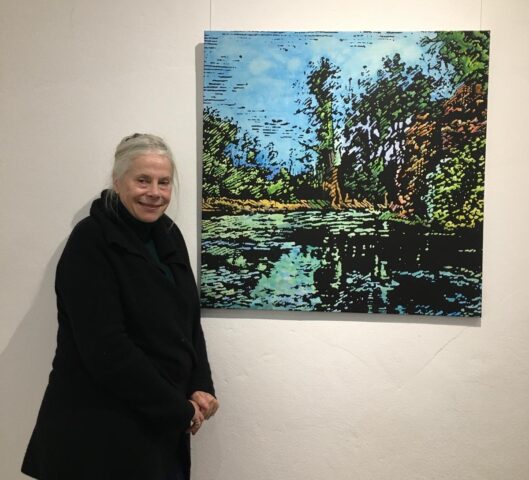
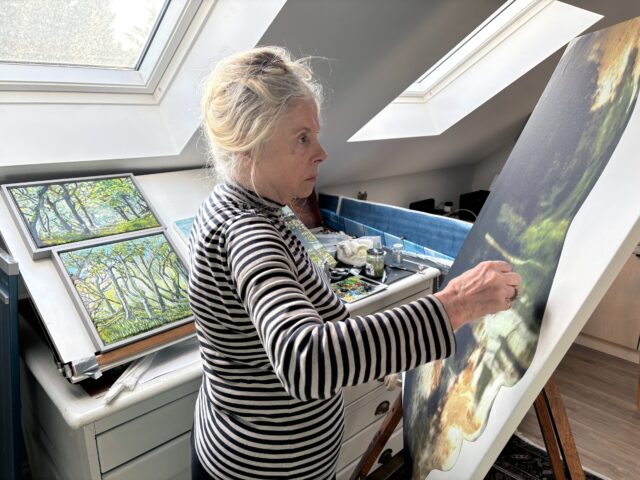
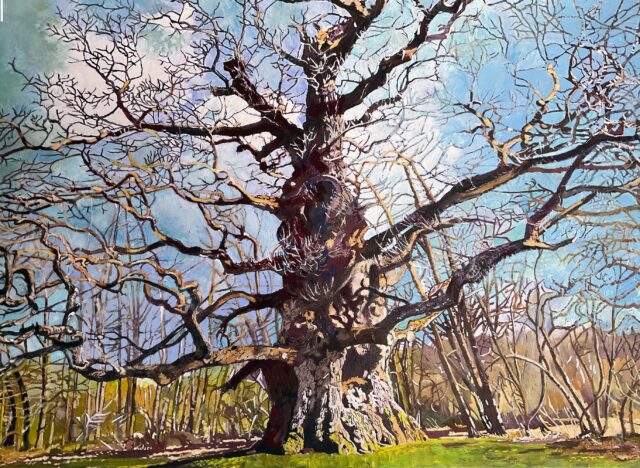
Over the years as an artist, she has explored a great variety of mediums in her art – a multidisciplinary artist working across sculpture, photography, printmaking and painting. In more recent years she has been working and exhibiting annually creating surveys of Dartmoor and Exmoor National Parks, ancient English trees at Nonington in Kent and Stavington in Suffolk. She is presently working on a series of paintings about the City of London where she worked as a principal lecturer in fine art at the Central Saint Martin’s College of Art which will be exhibited with Urban Contemporaries
As the conversation moves back to Traces of Humanity, she recognises that being a curator is all about a continuing process – “before one project is finished, I am asked to start another. My role as a curator is to choose the theme, find the artists and keep them fairly happy until the project is complete.”
Artists, she says, see themselves as the stars.
“As the most important, they couldn’t be professional artists without this amour propre. I understand this because as an artist myself I know this feeling, and as a curator I respect each artist’s vision and do the best I can for them. It is like being a mother and a child simultaneously, which of course all women know about.”
For this latest project – Traces of Humanity she has created four exhibitions to enable Gibraltarian artists to exhibit at the Schwartzman Gallery in the High Street Margate (open last week), followed by the Lloyds Artists at the same venue. The Gibraltar artists then travel to the Noho Studios, a London gallery in the West End. Afterwards all the art will be shipped to Gibraltar for a big exhibition at the Gustavo Bacarisas Gallery. The exhibition will be officially opened by Minister for Culture Christian Santos, and will feature talks by Professors Clive and Geraldine Finlayson of the Gibraltar National Museum; educational events for schools, and a special gathering for the sponsors and partners within the Insurance Market. Together with husband Chris Plato they have designed a catalogue for the project.
Her aim, in organising this latest project is to continue to create more projects for Gibraltar, working with Gibraltar Cultural Services.
“Gibraltarian artists were always special, rooted in their culture and they continue to become more confident creating their imagery in and about Gibraltar. Our first show – Gibraltar as seen by Five Artists, was featured on BBC Radio 1 and we haven’t looked back since,” she adds.
She believes the projects have inspired more local artists to respond by producing major works.
“My aim has always been to promote important international events for local artists. Another aspect is to enable local artists to exhibit with and therefore measure themselves against and make contact with international artists living in the UK.”
She believes Gibraltarians should understand that their artists, poets, musicians and authors do not need validation in any way shape or form, and that their very existence represents their importance to Gibraltarian culture as something which should be treasured by all.
Her hope is that she has inspired local professionally trained Gibraltarian artists to feel valued by the wider international art community.
She remains confident that what she is achieving by creating such projects is of real importance for both local art and local artists.
In – Traces of Humanity, all selected artists have been encouraged to explore the theme through painting, printmaking, sculpture, video and installation. Those exhibiting in the UK, in both Margate and London, are Ambrose Avellano, Ermelinda Duarte, Mark Montovio, Alan Perez, Monica Popham, Sebastian Rodriguez, Michele Stagnetto and Karl Ullger.
[ad_2]
Source link