[ad_1]
The cofounders of Dataland, the new museum of AI arts in Los Angeles, have revealed details of the technology partnerships behind what they are calling the world’s first omni-sensory museum.
Refik Anadol and Efsun Erkılıç have unveiled Data.Link, an intelligent system connecting art, architecture, and audience through advanced AI systems, real-time data assimilation, integrated technologies, and wearable devices.
Designed with Gensler and engineered by Arup, with support from Constellation Immersive, Dataland was conceived as a new model for twenty‑first‑century cultural institutions.
Aspiring to set the standard for how AI Arts is presented, curated, and experienced, the museum integrates advanced technologies seamlessly into the building’s walls, ceilings, and floors, allowing infrastructure to disappear into the architecture, while turning the building into an active participant in the experience.
Made possible by Nvidia, Dataland developed Connectome, a centralised high‑performance computing system that serves as the museum’s neural centre, giving every installation the capacity to process and respond in real time. Connectome orchestrates data streams across every gallery, allowing each artwork to “dream” in direct dialogue with its environment.
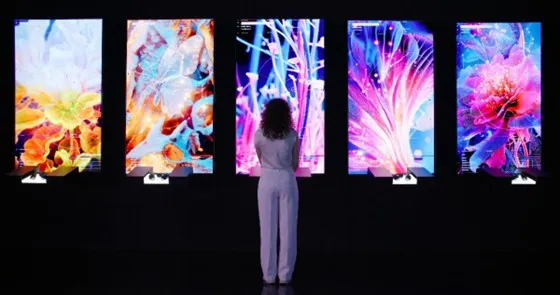
For Dataland’s inaugural exhibition Machine Dreams: Rainforest, the system seamlessly integrates live ecological data from rainforests around the world, the Large Nature Model (LNM) AI system, and biosensing input from visitors’ wearable devices, forming the computational foundation behind the experiences.
Created by Refik Anadol Studio, the LNM is described as the world’s first open‑access multi‑modal AI based solely on nature data. To support the future of AI arts, the LNM is hosted on Google Cloud in a low‑CO2 compute zone in Oregon, operating on 87% carbon‑free renewable energy.
The LNM uses roughly one smartphone charge to reiterate the artwork for every visitor, reflecting Dataland’s commitment to building intelligent systems that expand the possibilities of art while minimising their environmental footprint.
Touch that responds
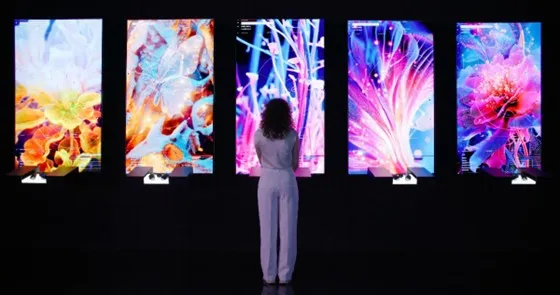
Dataland’s partnership with digital health and wearables company Empatica allows visitors to connect directly to the building and the artwork. Empatica’s EmbracePlus, an FDA-cleared wearable biosensing device, incorporates the collective visitors’ emotional reactions through real-time measurements of heart rates, skin temperatures, and skin conductivity.
To achieve this, Empatica created a custom version of its medical technology for consumer use, exclusively for Dataland with software and algorithms that have been adapted to enable data streaming in real time. Data.Link translates these anonymised physiological signals captured by EmbracePlus, together with live environmental data, into a language the LNM can interpret as emotion. The LNM responds in kind by reshaping what visitors experience to create a machine dream that is not pre-programmed, but a dialogue between art and audience.
Touch that creates
Three LG transparent touchscreens in the museum’s Latent Gallery invite visitors to create their own art in real-time by tapping into the deep knowledge of the LNM. In concert with Dataland’s mission to demystify AI Arts, visitors can explore the LNM’s vast dataset — over 500 million images responsibly sourced through partners including the Smithsonian, the Cornell Lab of Ornithology, Getty, iNaturalist and London’s Natural History Museum. Visitors can also use the AI system to paint with what Anadol calls a “thinking brush” with results shown in real-time on a large media wall.
Seeing beyond the frame
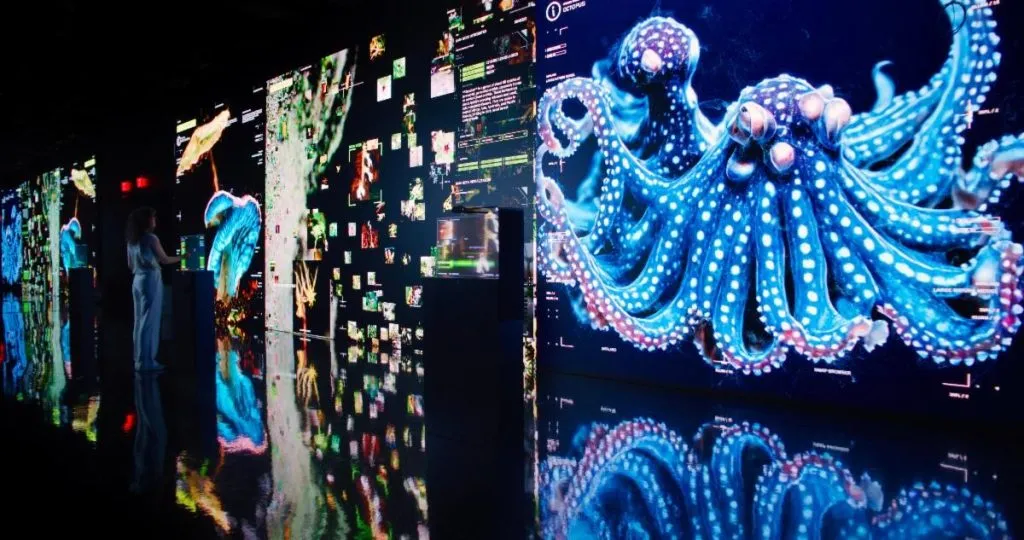
Through collaborations with Epson, LG, and custom LEDs throughout, the five galleries at Dataland feature a combined total of 1.5 billion pixels. In the largest gallery, the Data Pavilion, 84 x 4K projectors by Epson generate over 8 million pixels and 20,000 lumens each and move seamlessly as one by employing Scalable’s advanced algorithmic technology. Using cameras to capture the projected images, and software that automatically aligns, blends, and colour-matches every pixel, seams disappear and curved surfaces look flawless.
In the Infinity Room, visitors step inside a three-dimensional LED cube with panels completely covering the walls, ceiling and floor. Across five galleries, Dataland comprises 1,577 custom 10K LED panels totalling more than 300 sq metres, with 28 LG displays interspersed throughout.
An olfactive journey through the rainforest
L’Oréal Luxe, Dataland’s founding olfactory partner, has co-developed a first-of-its-kind scent journey inspired by the rainforests of the world. To achieve this, L’Oréal Luxe leveraged its unique fragrance model, empowering the L’Oréal Fragrance Métiers to co-create 12 avant-garde olfactive imprints. Drawing from the LNM as a creative reference, these scents are not traditional perfumes designed to be worn, but projective olfactory experiences.
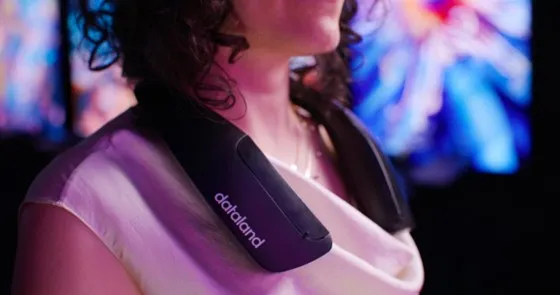
Among them, Scent of Data blends clean musks and aldehydes to replicate the algorithmic pulsation of code, scenting the “mind” of the machine. Scent of Rain delivers a hyper-realistic atmosphere of humid earth after rain, featuring the characteristic petrichor accord, headspace-captured and earthy patchouli facets. These fragrances will be revealed throughout the exhibition via Dataland’s own wearable scent devices. This dedicated hardware allows each visitor to embark on an individualised journey that evolves as they move through the galleries. Emitting scents exclusively for the wearer, the device’s advanced diffusion technology ensures that the scent molecules dissipate instantly, leaving no residue on either the visitor or the environment.
The architecture of sound
Dataland’s 250-speaker audio ecosystem is driven by L-ISA immersive sound from L-Acoustics. L-ISA technology delivers a living soundtrack that evolves in real time, woven from original music by composer and sound designer Kerim Karaoğlu, the acoustic ecology of the rainforest, and the sacred healing songs of the Yawanawá. L-Acoustics L-Smart technology continuously monitors and optimises power consumption to average 30% greater efficiency, with zero compromise to the sound. Suspending audio dynamically across a three-dimensional canvas — in front of, above, and entirely surrounding the visitor — Dataland is said to achieve a spatial resolution with no precedent in any permanent museum.
The taste of data
Inside the Latent Gallery, Dataland introduces a new medium of data sculpture: Data.Chocolate, an exclusive limited‑edition edible experience. Created with Valerie Gordon of Valerie Confections, Data.Chocolate represents a first‑of‑its‑kind dialogue between algorithmic data processing and human culinary intuition. The artwork translates machine-generated concepts—derived from immense datasets of cacao genetics and the Amazon rainforest—into an avant-garde four-piece tasting collection.
Commenting on the museum, cofounder Refik Anadol said: “For 5000 years, humans have been emotionally moved by artworks, but the relationship has always flowed in one direction. While developing Dataland we asked ourselves, ‘Is it possible for artworks to feel us back?’ We dreamed of a place where audience and artwork could merge, creating a feedback loop of collective emotion. Through collaborations with extraordinary innovators and technologies woven directly into the architecture itself, that dream has now become reality.”
Cofounder Efsun Erkılıç added: “Collaborating across disciplines has always shaped how we think and create; it is inseparable from our way of being. Our own practice emerges from the convergence of art, science, and technology – a collaboration of complex intelligences to develop a collective memory based on shared knowledge. At Dataland, we honour that complexity by highlighting the many minds, processes, and intelligences that have been animating our vision for years.”
Dataland opens on 20 June in downtown Los Angeles at The Grand LA development.
[ad_2]
Source link